




Last updated: October 2026 · By the OptimumFusion Team
Quick answer: Glutamine is the main fuel for the cells lining your gut, and hard training in heat can stress that lining. Studies on athletes running in the heat found that glutamine taken about 2 hours before exercise may help support gut barrier markers, with the clearest effects at higher doses (around 0.9 g per kg of fat-free mass). For most UAE gym-goers, a practical routine is 5–10 g per day, with good hydration and a gut-friendly pre-workout meal doing most of the work.
Key Takeaways
- Glutamine is the most abundant amino acid in the body and a key energy source for the cells that line your intestines.
- Long or intense sessions, especially in UAE heat, divert blood away from the gut, which may stress the gut lining and cause cramps, bloating or nausea during training.
- Research in hot conditions suggests glutamine may help support gut barrier markers, but the evidence is still small and mostly from endurance exercise.
- A realistic daily intake for lifters is 5–10 g, split around training; very high study doses are not needed for most people and can upset the stomach.
- Hydration, sodium, meal timing and smart food choices matter more for gut comfort than any single supplement.
What Glutamine Does in Your Gut
Glutamine is a "conditionally essential" amino acid. Your body makes it, mostly in muscle tissue, but during periods of heavy physical stress the demand can rise faster than you produce it. One of the biggest users of glutamine is your small intestine: the cells lining it (called enterocytes) use glutamine as a preferred fuel to stay healthy and renew themselves every few days.
Those cells also hold together through "tight junctions", which act like a seal between the inside of your gut and your bloodstream. When that seal is stressed, small fragments can pass through more easily. This is called increased intestinal permeability.
| Role | What it means for a gym-goer |
|---|---|
| Fuel for gut-lining cells | Supports normal renewal of the intestinal lining |
| Tight junction support | May help maintain the gut barrier during exercise stress |
| Nitrogen transport | Moves nitrogen between tissues, part of normal protein metabolism |
| Immune cell fuel | Used by immune cells, which are concentrated around the gut |
| Muscle stores | Muscle holds the body's largest glutamine reserve |
If you want the wider overview of glutamine for recovery, our guide on L-glutamine benefits for gym recovery covers what the evidence does and does not support.
Why Training in the UAE Can Stress Your Gut
During exercise your body sends blood to working muscles and to the skin to release heat. Blood flow to the gut can drop sharply as a result. Researchers led by Ricardo Costa have described this as "exercise-induced gastrointestinal syndrome": a mix of reduced gut blood flow, gut barrier stress and digestive symptoms that grows worse with longer duration, higher intensity and higher temperatures.
That last factor is where the UAE comes in. Training outdoors in Dubai or Abu Dhabi between May and October, or in a gym with weak air conditioning, means your body works harder to cool down. Dehydration makes it worse, because lower blood volume leaves even less blood for the gut. In Ramadan, low fluids plus a heavy iftar can add to discomfort.
| Gut stress factor | Higher risk situation | Practical fix |
|---|---|---|
| Heat | Outdoor runs or sessions above 30°C | Train early morning or late evening, indoors when possible |
| Dehydration | Losing more than 2% of body weight in sweat | Weigh yourself before and after; drink about 1.25–1.5 L per kg lost |
| Session length | Over 60–90 minutes of continuous work | Sip fluids with electrolytes during training |
| Intensity | High-intensity intervals, long circuits | Build volume gradually |
| Pre-workout meal | High fat or high fibre within 1–2 hours | Choose lighter, easy-to-digest carbs and protein |
| Ramadan timing | Training right after a heavy iftar | Wait 2–3 hours after a big meal, or train before iftar with a lighter load |
For more on staying safe and hydrated in hot months, read training in UAE summer heat and our guide to electrolytes for gym hydration.
What the Research Says About Glutamine and Gut Health
The most cited human work comes from heat studies. A 2017 study by Pugh and colleagues, published in the European Journal of Applied Physiology, had trained men run for 60 minutes in the heat after taking different doses of glutamine about 2 hours earlier. Markers of gut permeability were lower after glutamine than after placebo, and the effect appeared to be dose-dependent, with the highest dose (0.9 g per kg of fat-free mass) showing the clearest result. Earlier work by Zuhl and colleagues at the University of New Mexico reported similar findings with glutamine taken over several days before exercise in the heat.
It is important to keep this in perspective:
- The studies were small, mostly in runners, and measured lab markers rather than long-term outcomes.
- The highest doses were large. For a man with 65 kg of fat-free mass, 0.9 g/kg equals roughly 58 g, which is far beyond normal supplement use and may itself upset the stomach.
- The International Society of Sports Nutrition (ISSN) exercise and sports nutrition review places glutamine among supplements with limited evidence for direct performance or muscle-building benefits in healthy, well-fed lifters.
So the honest summary is: glutamine is not a muscle builder, but it may help support gut barrier function when training stress and heat are high. It is a "support" supplement, not a fix-all.
| Dose approach | Amount (example: 80 kg man, ~65 kg fat-free mass) | Who it suits |
|---|---|---|
| Daily maintenance | 5 g once a day | Regular gym-goers wanting basic support |
| Heavy training block | 10 g per day (5 g before + 5 g after) | High volume, two-a-days, summer training |
| Research-level heat dose | 0.25–0.9 g/kg fat-free mass (16–58 g) | Only studied in labs; not needed for most people |
How to Use Glutamine for Gut Comfort: A Simple Routine
You do not need complicated protocols. A practical approach for a male lifter in the UAE looks like this:
- Morning or pre-workout: 5 g of L-glutamine in 300–500 ml of water, about 1–2 hours before training, alongside a light meal.
- Post-workout: another 5 g on heavy or long training days, mixed with your protein shake or water.
- Hydration: aim for clear to pale-yellow urine and replace sweat losses with water plus electrolytes.
- Meal timing: keep high-fat or high-fibre meals at least 2–3 hours away from intense sessions.
- Ramadan: take glutamine at suhoor or after iftar, since you cannot drink during fasting hours, and keep training intensity moderate on long fasting days.
If bloating after shakes is your main issue, it may be the protein type or how fast you drink it rather than your gut lining. Our guide on whether protein can cause bloating walks through the common causes and fixes.
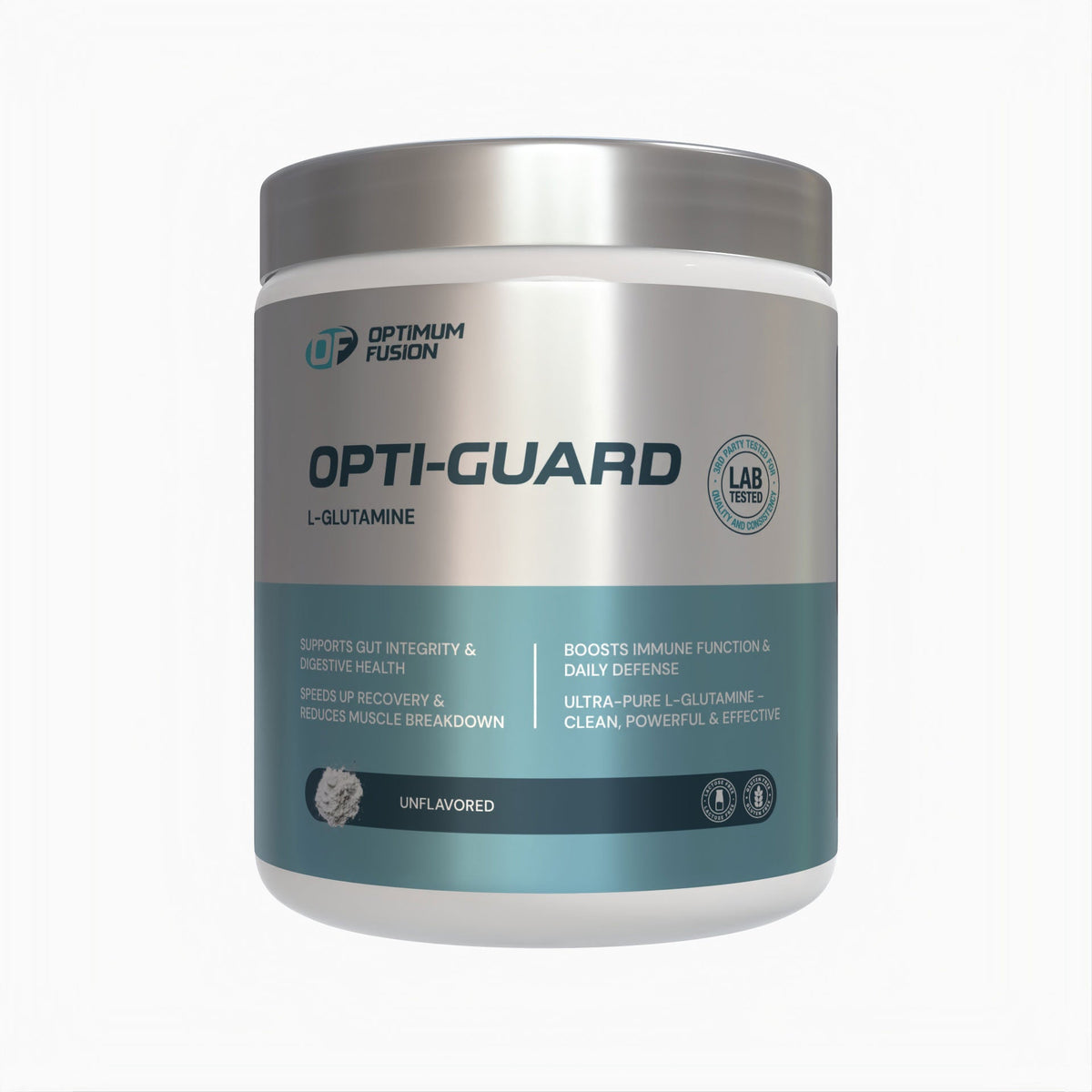
Opti Guard: Simple, Clean L-Glutamine
If you want an easy way to add glutamine to your routine, Opti Guard L-Glutamine keeps it simple: each serving gives you 5 g of L-glutamine, and every tub provides 70 servings. That matches the daily maintenance dose above, and you can take two servings on heavy training days.
Opti Guard is halal certified and third-party lab tested, so you know what is inside each scoop matches the label. It mixes easily into water or a shake, with fast delivery across the UAE.
You can see full details on the Opti Guard product page.
Health note: Glutamine is generally well tolerated by healthy adults at typical doses. Speak with your doctor before using it if you have kidney or liver conditions, a diagnosed digestive condition, are taking any medication, or are under 18. Supplements are not a substitute for medical care, so persistent stomach pain, blood in the stool or ongoing digestive symptoms should always be checked by a doctor.
Frequently Asked Questions
Does glutamine help with stomach problems during workouts?
Glutamine may help support the gut lining during hard exercise, especially in hot conditions, based on small studies in athletes. It is not a substitute for medical advice on digestive conditions. For most gym-goers, staying hydrated, avoiding heavy meals close to training and building intensity gradually make the biggest difference to gut comfort.
How much glutamine should I take per day for gut health?
Most lifters use 5–10 g per day, split before and after training. Lab studies on gut permeability used much higher doses, up to 0.9 g per kg of fat-free mass, but those amounts are not necessary for everyday training and may cause stomach discomfort in some people.
When is the best time to take glutamine?
For gut support around training, take 5 g about 1–2 hours before your session, as that matches the timing used in heat studies. A second 5 g serving after training works well on heavy days. During Ramadan, take it at suhoor or after iftar.
Can I mix glutamine with my protein shake or creatine?
Yes. L-glutamine is tasteless or nearly tasteless and mixes well with whey, beef protein or creatine. Mixing them simply makes your routine easier.
Do I need glutamine if I already eat enough protein?
Not necessarily. Protein foods such as meat, fish, eggs and dairy already contain glutamine, and your body makes its own. Extra glutamine is most useful when training load is high, sessions are long, or you often train in the heat, which describes many gym-goers in the UAE during summer.
Is glutamine halal and safe to use in the UAE?
Glutamine itself is an amino acid, but the source and processing matter, so always choose a product that is halal certified and third-party lab tested. Opti Guard meets both standards. Healthy adults generally tolerate typical doses well; check with a doctor if you have a medical condition or take medication.
The Bottom Line
Glutamine is not a magic muscle builder, but it plays a real role in keeping your gut lining fuelled, and research in hot conditions suggests it may help support gut barrier markers when training stress is high. For UAE gym-goers, the winning formula is simple: 5–10 g of glutamine a day, smart hydration, good meal timing and gradual progress. To set your full daily protein and macro targets, use our free protein and macro calculator, and read our workout nutrition timing guide and sleep and muscle recovery guide to round out your routine.
Share:
Fish Oil vs Eating Fish: How Much Omega-3 Do You Get? (UAE)
Carb Cycling for Gym: How to Plan High & Low Carb Days (UAE)