




Last updated: October 2026 · By the OptimumFusion Team
Quick answer: Training in UAE summer heat is safest indoors in an air-conditioned gym, or outdoors only before about 7 am or after sunset, when temperatures and sun load drop. Give your body 10–14 days to acclimatise, start every session hydrated, and use an electrolyte drink with roughly 300–700 mg of sodium for sweaty sessions. Stop immediately if you feel dizzy, confused, nauseous or stop sweating normally, and call 998 for an ambulance if someone shows signs of heat stroke.
Key Takeaways
- Heat stroke is a medical emergency. Confusion, collapse or a very high body temperature means call 998 and start cooling right away.
- Timing beats toughness. Midday outdoor training in a UAE summer adds risk without adding results.
- Acclimatisation takes about 10–14 days of gradual heat exposure.
- Sweat losses can reach 1–2 litres per hour or more in heat, so replace both fluid and sodium.
- Go easy on high-stimulant pre-workouts in hot conditions. They raise heart rate and can mask warning signs.
Heat Exhaustion vs Heat Stroke: Know the Signs
Summer in Dubai, Abu Dhabi and Al Ain regularly brings temperatures above 40 °C, and coastal humidity makes it harder for sweat to evaporate and cool you down. The American College of Sports Medicine (ACSM) position stand on exertional heat illness and the National Athletic Trainers' Association (NATA) position statement on exertional heat illnesses (2015) both stress one thing: recognise it early and cool fast.
| Heat exhaustion | Heat stroke | |
|---|---|---|
| Main signs | Heavy sweating, weakness, dizziness, headache, nausea, cramps, pale clammy skin | Confusion, slurred speech, odd behaviour, collapse, seizures; skin hot (may be sweaty or dry) |
| Body temperature | Raised, usually below 40 °C | Usually above 40 °C |
| What to do | Stop training, move to shade or AC, lie down with legs raised, sip fluids with electrolytes, cool with wet towels | Call 998 immediately. Cool the person aggressively (cold water, ice packs on neck, armpits, groin) while waiting |
| Return to training | Rest for the remainder of the day; resume gradually once fully recovered | Only after medical clearance |
Do not "push through" dizziness or confusion. Heat stroke can progress quickly, and NATA's guidance is clear that rapid cooling on site is what saves lives.
Best Times to Train and Indoor vs Outdoor
From roughly June to September, the sun is the main enemy. The UAE's midday outdoor work break (12:30–3:00 pm in summer months) exists for good reason, and the same logic applies to exercise.
| Option | Heat risk | Best for |
|---|---|---|
| Indoor AC gym, any time | Low | Strength, hypertrophy, most training |
| Outdoors before 7 am | Moderate (humidity can still be high) | Easy runs, cycling, walks |
| Outdoors after sunset | Moderate | Running, sports, conditioning |
| Outdoors 10 am–5 pm | High | Not recommended in summer |
| Indoor sports halls / pools | Low to moderate | Team sports, swimming |
Remember the commute. Walking from a car park in 45 °C heat or training after a day outdoors means you may arrive already partly dehydrated. If you prefer to lift late, our guide to the best pre-workout for night training covers sleep-friendly options.
Acclimatisation: Give It 10–14 Days
A widely cited 2015 review by Périard, Racinais and Sawka in the Scandinavian Journal of Medicine & Science in Sports found that most heat adaptations, including earlier and greater sweating, lower heart rate and lower core temperature, develop over about 10–14 days of repeated heat exposure.
| Days | What to do outdoors |
|---|---|
| 1–3 | 20–30 minutes at easy effort, cool time of day |
| 4–7 | 30–45 minutes, mostly easy, short harder efforts |
| 8–14 | Build back towards normal duration and intensity |
| After 1–2 weeks away | Expect to lose some adaptation; ease back in |
People returning from summer holidays abroad, or new arrivals to the UAE, should treat the first two weeks as adaptation, not a test.
Hydration, Sodium, Pre-Cooling and Clothing
Hydration and sodium. The ACSM reports sweat rates of about 0.5–2 litres per hour, and heat pushes you towards the top of that range. Sweat also carries sodium, so plain water alone is not enough for long sessions. A practical plan:
- Drink regularly through the day and have a normal meal with some salt 2–4 hours before training.
- Sip an electrolyte drink (around 300–700 mg sodium per serving) during sweaty sessions.
- Weigh yourself before and after. Replace about 1.25–1.5 litres for every 1 kg lost.
Full details are in our electrolytes for gym hydration guide.
Pre-cooling. A 2010 study by Siegel and colleagues in Medicine & Science in Sports & Exercise found that drinking an ice slurry before running in the heat lowered core temperature and extended running time compared with cold water. Simpler options work too: cold towels on the neck, a cold drink before you start, or a cooling vest.
Clothing.
- Light-coloured, loose, moisture-wicking fabric
- A cap or visor, sunglasses and sweat-resistant sunscreen
- Avoid sweat suits or "sauna" layers to cut weight. They trap heat and raise risk.
Supplements That Matter in the Heat
Most supplements are optional. In the heat, a few have a clear job.
| Supplement | Why it helps in heat | When it matters most |
|---|---|---|
| Electrolytes | Replace sodium and other minerals lost in sweat | Sweaty or 60+ minute sessions |
| EAAs + electrolytes | Hydration plus amino acids in one drink | Fasted or long sessions |
| Carbohydrates | Fuel and better fluid absorption | Sessions over about 60–90 minutes |
| High-stim pre-workout | Use with caution | Lower the dose or skip on hot days |
About stimulants: high caffeine doses raise heart rate and can make you feel less tired than you really are, which is the opposite of what you want in heat. On hot days, consider a smaller dose or a caffeine-free pre-workout, and never use a pre-workout as your hydration drink.
About creatine: the ISSN position stand on creatine (2017) reports that research has not shown creatine increases cramping or dehydration risk. There is no need to stop taking it in summer, as long as you stay well hydrated.
For how to build your drink, read our intra-workout drink guide.
The Head of The Table and Opti-Carbs: Your Summer Bottle
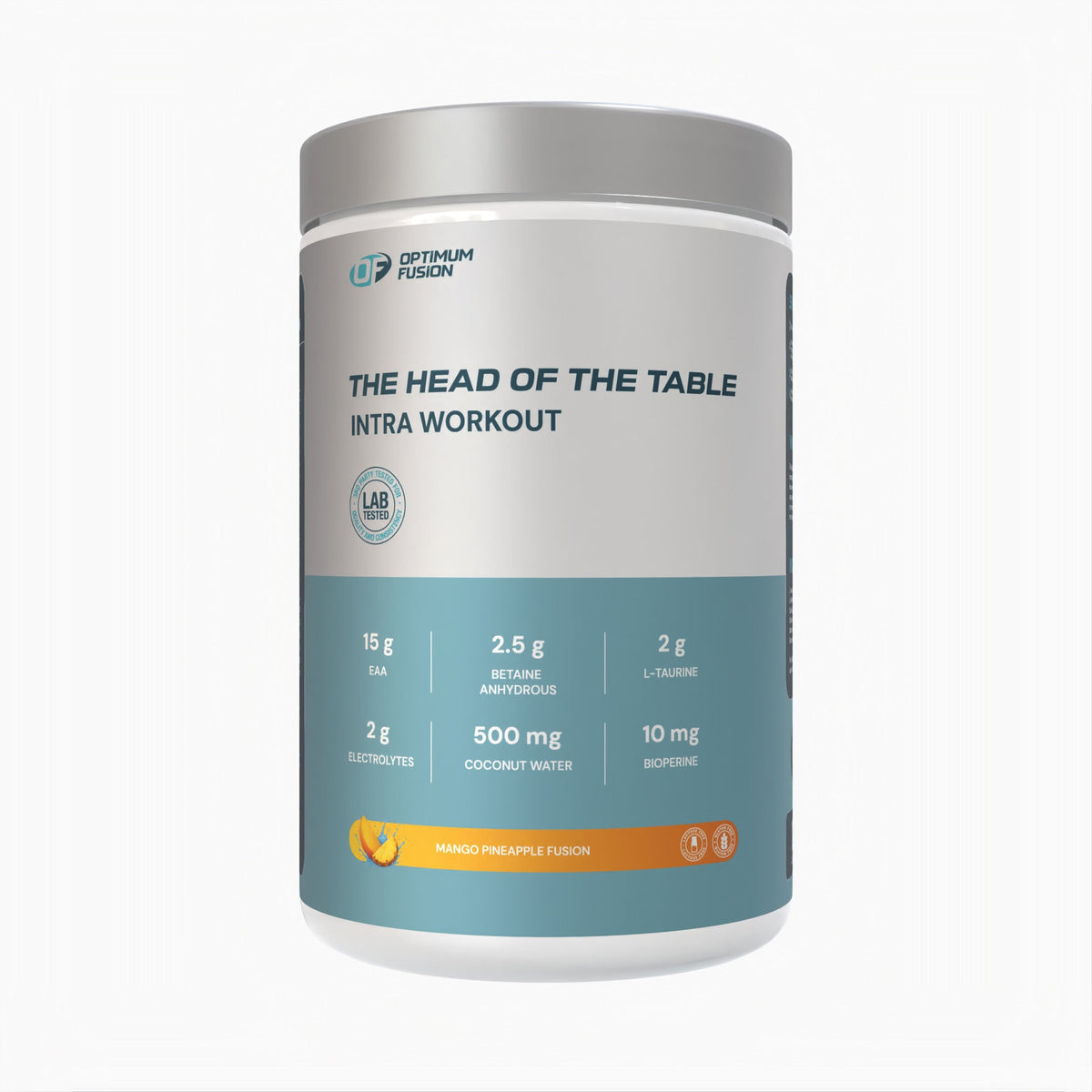
The Head of The Table is our EAA + electrolyte intra-workout drink. Per serving:
- 15 g EAAs, including 3.5 g leucine
- 2.5 g betaine anhydrous and 2 g taurine
- Five-mineral electrolyte blend
- 500 mg coconut water powder
- 30 servings; flavours Watermelon and Mango
Who it suits: lifters and athletes training in sweaty conditions, early morning or fasted sessions, and anyone who wants hydration and amino acids in one bottle.
Opti-Carbs adds fuel for longer sessions. Per 30 g scoop:
- 28 g carbs from Cluster Dextrin + Karbolyn®, 0 g sugar, 112 kcal
- 200 mg sodium, 145.5 mg potassium, 129 mg calcium, 21 mg magnesium
- 73 servings
How to use: mix 1 serving of The Head of The Table in 500–1,000 ml of cold water and sip throughout training. For sessions over 60–90 minutes, outdoor sport or two-a-days, add 1 scoop of Opti-Carbs to the same bottle. Both are halal certified and third-party lab tested. Get The Head of The Table delivered fast across all UAE emirates.
Health note: if you have a heart condition, high blood pressure, kidney disease, take medications such as diuretics or blood pressure tablets, are pregnant, or are under 18, speak to your doctor before training hard in heat or using higher-sodium or stimulant products.
Frequently Asked Questions
Is it safe to train outdoors in the UAE in summer?
It can be, if you train early morning or after sunset, acclimatise over 10–14 days, hydrate with fluids and sodium, and stop at the first warning signs. Training outdoors between late morning and late afternoon in summer carries a high risk and is best avoided.
What are the first signs of heat exhaustion?
Common early signs are heavy sweating, dizziness, headache, nausea, weakness, muscle cramps and pale, clammy skin. Stop training, get into shade or air conditioning, cool down and sip fluids with electrolytes.
When should I call an ambulance for heat illness?
Call 998 if someone becomes confused, slurs their speech, collapses, has a seizure or feels very hot to the touch during or after exercise. Start cooling them with cold water and ice packs while you wait.
How much water should I drink when training in the heat?
It depends on your sweat rate, which can be 1–2 litres per hour or more in UAE heat. Weigh yourself before and after training and replace about 1.25–1.5 litres for every 1 kg lost, using electrolytes for sweaty sessions.
Can I take pre-workout in hot weather?
You can, but high-stimulant pre-workouts raise heart rate and can mask fatigue, so lower the dose or choose a stimulant-free option on very hot days. Always bring a separate drink for hydration.
How long does it take to get used to training in the heat?
Most heat adaptations develop over about 10–14 days of gradual exposure, according to research reviews on heat acclimatisation. You lose some of that adaptation after one to two weeks away from the heat.
The Bottom Line
Training in UAE summer heat is about smart timing, gradual exposure and a well-planned bottle, not toughness. Train indoors or outside the hottest hours, replace fluid and sodium, and stop at the first warning signs. Set your daily nutrition targets with our free protein macro calculator, and if the heat leaves you drained, read tired at the gym: causes and fixes and our intra-workout drink guide.
Share:
High Protein Diet Plan for Beginners UAE: Meals & Targets
Halal Protein Powder UAE: How to Check Certification