




Last updated: September 2026 · By the OptimumFusion Team
Quick answer: The best pre workout for night training is a stimulant-free formula with ingredients like citrulline, beta-alanine, and glycerol that support performance without caffeine. Caffeine has a half-life of roughly 3–7 hours, and a 2023 meta-analysis found a typical pre-workout dose should be taken about 13 hours before bed to avoid cutting total sleep time. If you train after 6 pm, as many people in the UAE do, a zero-caffeine pre-workout protects the sleep your muscles need to recover.
Key Takeaways
- Caffeine lingers. Half of a dose can still be in your system 5 hours later, and a quarter after 10 hours.
- Poor sleep undermines training results more than a missing pre-workout ever will.
- Evening exercise itself is fine for sleep for most people; the caffeine is usually the problem.
- Stim-free pre-workouts keep the pump, endurance, and focus support without the late-night wiring.
- In the UAE, night training is often the smart choice because of heat, work hours, and Ramadan schedules.
Why So Many People Train at Night in the UAE
In many countries, evening gym sessions are a matter of preference. In the UAE, they are often a matter of practicality.
| Reason | What it means for your training |
|---|---|
| Summer heat | Daytime temperatures above 40°C push outdoor training (and even commuting) into the evening |
| Work hours | Office schedules in Dubai and Abu Dhabi leave the 7–11 pm window as the main free time |
| Ramadan | Training often moves to after iftar or late at night |
| Gym culture | Many gyms are busiest late and some are open 24 hours |
| Family time | Early evening goes to family, with training after |
The result: a large share of UAE lifters walk into the gym between 8 pm and midnight. Taking a standard caffeinated pre-workout at that hour is one of the most common reasons people complain they "sleep badly" despite training hard.
Caffeine Half-Life and Sleep: The Numbers
Caffeine's half-life in healthy adults is roughly 3–7 hours (commonly quoted as about 5), and it varies with genetics, medications, and smoking status. Here is what that looks like for a 200 mg pre-workout dose, assuming a 5-hour half-life:
| Time taken | Time now | Caffeine still active (approx.) |
|---|---|---|
| 8 pm | 8 pm | 200 mg |
| 8 pm | 1 am | 100 mg |
| 8 pm | 6 am | 50 mg |
| 8 pm | 11 am next day | 25 mg |
What the research says:
- A 2013 study in the Journal of Clinical Sleep Medicine (Drake and colleagues) found that 400 mg of caffeine taken even 6 hours before bed reduced total sleep by more than an hour.
- A 2023 systematic review and meta-analysis in Sleep Medicine Reviews (Gardiner and colleagues) estimated that a typical coffee should be consumed at least 8.8 hours before bed, and a typical pre-workout supplement dose at least 13.2 hours before bed, to avoid reducing total sleep time.
People often say "caffeine doesn't affect me." You may fall asleep fine, but research shows caffeine can still reduce deep sleep and sleep efficiency even when you do not notice it.
Does Evening Exercise Hurt Sleep?
For most people, no. A 2019 meta-analysis in Sports Medicine (Stutz and colleagues) found that evening exercise generally did not impair sleep, and in some cases slightly improved deep sleep. The exception was vigorous exercise ending less than about 1 hour before bedtime, which could delay falling asleep.
So the practical rule is simple: train in the evening if that suits your life, finish at least an hour before bed, and remove the caffeine.
A Night-Training Routine That Protects Sleep
| Time before bed | What to do |
|---|---|
| 3–4 hours | Light meal with carbs and protein if you have not eaten recently |
| 2.5–3 hours | Stim-free pre-workout, 20–30 min before training |
| 2–2.5 hours | Train (keep sessions to 60–75 minutes where possible) |
| 1–1.5 hours | Post-workout meal or shake, rehydrate with electrolytes |
| 30–60 min | Dim lights, cool room (around 18–20°C), screens down |
Other night-training tips:
- Cut all caffeine after about midday if you train late. That includes coffee, tea, cola, and energy drinks.
- Avoid "just a little" caffeinated pre-workout. Even 100 mg late in the evening can reduce sleep quality.
- Watch the post-workout snack. A heavy, greasy meal right before bed can disturb sleep more than a balanced one.
- Rehydrate early. Drinking large volumes right before bed means waking up at night. See our electrolytes for gym hydration guide.
For how pre-workout and post-workout meals fit together, read our workout nutrition timing guide.
What a Good Night Pre-Workout Contains
Removing caffeine does not mean removing performance. These ingredients work through blood flow, acid buffering, and hydration, not stimulation:
- Citrulline malate (6–8 g): research suggests it may support training volume and pumps. A 2019 meta-analysis in the Journal of Strength and Conditioning Research reported small but significant improvements in strength and power performance.
- Beta-alanine (3.2–6.4 g daily): the ISSN position stand (2015) notes it supports performance in efforts lasting about 1–4 minutes, like high-rep sets.
- Glycerol: supports fluid retention and fuller-looking muscles, useful after a hot UAE day.
- Alpha-GPC: a choline source studied for focus and power output.
The Final Boss: Built for Evening Sessions
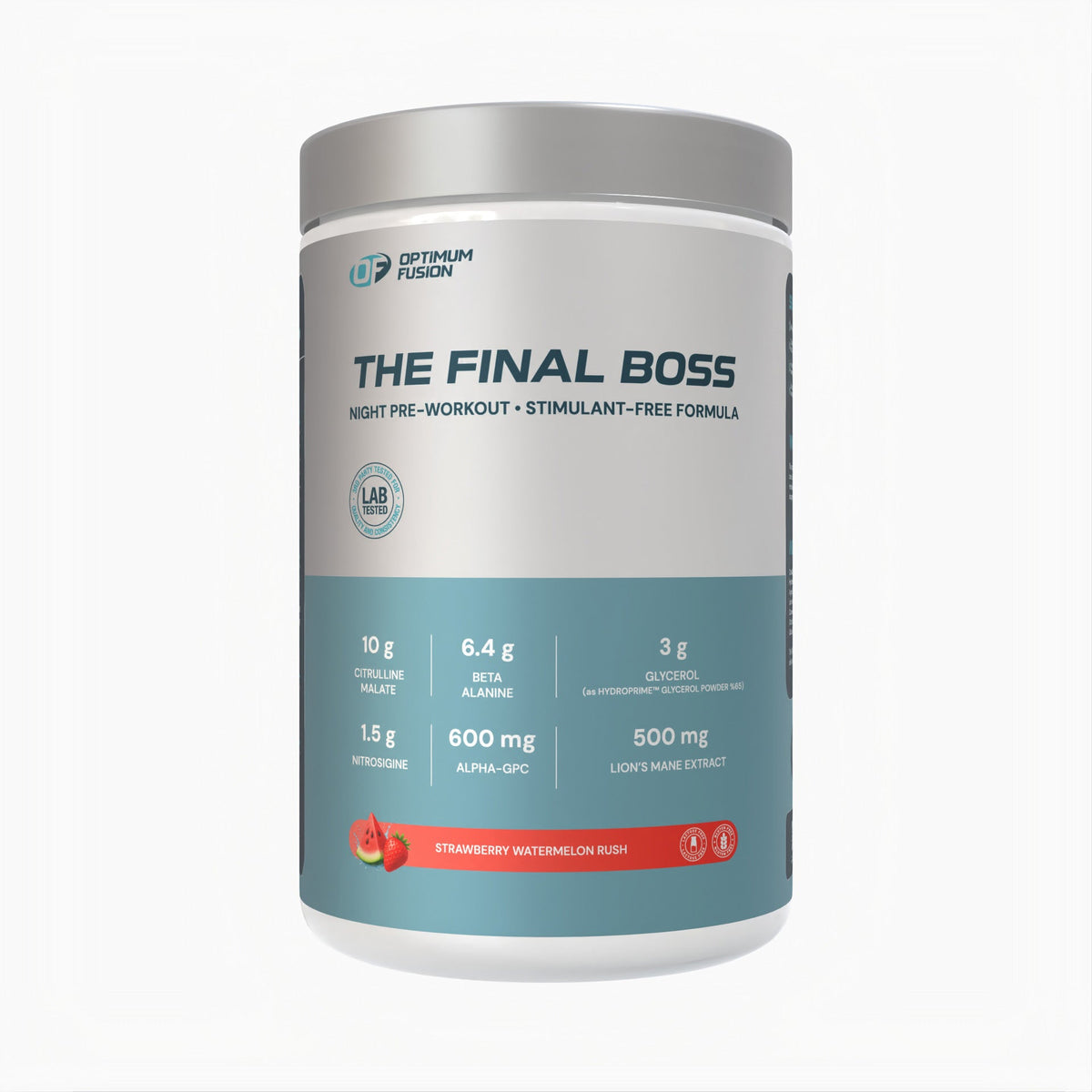
The Final Boss is our stimulant-free night pre-workout, with zero caffeine. Each serving contains:
- 10 g citrulline malate for blood flow and pumps
- 6.4 g beta-alanine for high-rep endurance
- 3 g glycerol for hydration and fullness
- Betaine anhydrous, Nitrosigine®, and agmatine sulfate for pump support
- 600 mg Alpha-GPC and 500 mg Lion's Mane for focus support
- Vitamins B6 and B12
- 500 mg coconut water powder
- 26 servings, third-party lab tested
- Halal certified
Who it suits: anyone training after about 5–6 pm, people who want big pumps and endurance without caffeine, and lifters taking a break from stimulants.
How to use: mix one serving in 300–400 ml of cold water and drink 20–30 minutes before training. The beta-alanine may cause a harmless tingling feeling.
Prefer a lighter stim-free option? High Chief is also caffeine-free, with 6 g citrulline malate, 3.2 g beta-alanine, 800 mg Alpha-GPC, and 1 g Lion's Mane per serving (30 servings). It suits people who want a stronger focus emphasis with moderate pump ingredients.
If you train in the morning some days, a caffeinated option makes sense there. See pre workout for energy and focus for daytime choices.
Health note: if you take blood pressure medication, have a medical condition, are pregnant or breastfeeding, or are under 18, speak to a doctor before using any pre-workout, including stimulant-free products.
Frequently Asked Questions
What is the best pre-workout for night training?
A stimulant-free pre-workout is the best choice for evening sessions because it supports performance without caffeine disrupting your sleep. Look for effective doses of citrulline malate, beta-alanine, and glycerol, like those in The Final Boss.
How late can I take a caffeinated pre-workout?
A 2023 meta-analysis in Sleep Medicine Reviews suggested a typical pre-workout dose should be taken about 13 hours before bed to avoid reducing total sleep time. For most people that means caffeinated pre-workouts belong in the morning or early afternoon only.
Will training at night ruin my sleep?
Usually not. Research suggests evening exercise does not impair sleep for most people, as long as vigorous training ends at least an hour before bedtime and you avoid caffeine late in the day.
Does a stim-free pre-workout actually work?
Yes, ingredients like citrulline, beta-alanine, and glycerol support performance through blood flow, acid buffering, and hydration rather than stimulation. You will not feel a caffeine "rush," but your pumps, endurance, and training volume can still benefit.
Can I take a night pre-workout during Ramadan?
Many people use a stimulant-free pre-workout after iftar, since training often happens late in the evening during Ramadan. Eat a light meal first, hydrate well between iftar and suhoor, and speak to a doctor if you have any medical condition.
What should I eat after training at night?
A balanced meal or shake with protein and some carbohydrates works well, eaten one to two hours before bed. Keep it moderate in size and avoid very heavy or greasy food so it does not disturb sleep.
The Bottom Line
Night training is part of life in the UAE, and it can work brilliantly as long as caffeine does not follow you to bed. Choose a stim-free pre-workout like The Final Boss, finish training at least an hour before sleep, and treat sleep as part of your program. Plan your daily protein and calories with our free macro calculator, and see what else supports recovery in our guide to post workout recovery supplements.
Share:
Collagen Peptides for Athletes: Dose, Timing & Tendon Support
Sleep and Muscle Recovery: How Much You Need & How to Improve