




Last updated: September 2026 · By the OptimumFusion Team
Quick answer: Most studies on collagen peptides for athletes use 10–15 g per day. For tendon and ligament support, the best-known protocol (Shaw et al., 2017) gave collagen with vitamin C about 30–60 minutes before a short bout of loading exercise. Collagen may support connective tissue and skin, but it is not a complete protein, so it shouldn't replace whey or meals for muscle building.
Key Takeaways
- 10–15 g of collagen peptides per day is the range most research uses.
- Timing matters for tendons: take it with vitamin C 30–60 minutes before loading or rehab exercises.
- Collagen is not a complete protein. It lacks tryptophan and is low in leucine, so it doesn't count fully toward your muscle-building protein.
- Skin research uses smaller doses (around 2.5–10 g per day) over 8–12 weeks.
- Consistency beats perfection: connective tissue adapts slowly, so think in months, not days.
What Collagen Actually Does in an Athlete's Body
Collagen is the main structural protein in tendons, ligaments, cartilage, bone, and skin. Type I collagen dominates tendons, ligaments, bone, and skin. Type II collagen is the main type in cartilage.
Collagen peptides (also called hydrolyzed collagen) are collagen broken down into small chains so they dissolve easily and are absorbed well. After digestion, your blood sees a rise in glycine, proline, and hydroxyproline, the building blocks your body uses to make its own collagen.
Why athletes care:
- Tendons and ligaments have a poor blood supply and adapt slowly to training.
- Heavy lifting, jumping, and running load connective tissue repeatedly.
- Tendons often lag behind muscles. Your squat can go up faster than your patellar tendon adapts.
Collagen won't replace smart programming, but it may give tendons more raw material at the moment they're being loaded.
How Much Collagen Should Athletes Take?
| Goal | Dose studied | Timing | Research example |
|---|---|---|---|
| Tendon / ligament support | 15 g gelatin or collagen + ~50 mg vitamin C | 30–60 min before 5–10 min of loading | Shaw et al., 2017, American Journal of Clinical Nutrition |
| Activity-related joint discomfort | 10 g per day | Daily, 24 weeks | Clark et al., 2008, Current Medical Research and Opinion |
| Body composition with training (older men) | 15 g per day | After resistance training | Zdzieblik et al., 2015, British Journal of Nutrition |
| Skin elasticity | 2.5–5 g per day | Daily, 8 weeks | Proksch et al., 2014, Skin Pharmacology and Physiology |
The Shaw protocol explained: in the 2017 study, healthy men took 15 g of gelatin with vitamin C one hour before six minutes of rope skipping. Blood markers of collagen synthesis roughly doubled compared with placebo. Lab-grown ligaments treated with their blood also showed more collagen. It was a small study, but it gave athletes a clear, practical protocol.
Practical take: aim for 10–15 g of collagen peptides per day, with some vitamin C (a supplement or a piece of fruit), taken 30–60 minutes before your training or tendon rehab exercises.
Tendons, Joints, and Skin: What to Expect
Tendons and ligaments. The strongest signal comes from pairing collagen with loading. Collagen taken on a rest day while sitting on the sofa likely does less than collagen taken before isometric holds, slow eccentrics, or jumping drills. Tendons respond to tension, so the exercise is the trigger and collagen is the supply.
Joints. Clark et al. (2008) followed college athletes taking 10 g of collagen hydrolysate daily for 24 weeks and reported less activity-related joint discomfort than placebo. Results are promising but modest. For a broader look at joint ingredients like omega-3s and glucosamine, see our guide to top supplements for healthy joints.
Skin. Several randomised trials, including Proksch et al. (2014), suggest collagen peptides may support skin elasticity and hydration within 8–12 weeks. In the UAE, strong sun, air conditioning, and dry indoor air all take a toll on skin, so this is a welcome side benefit for many gym-goers in Dubai and Abu Dhabi.
Realistic timeline:
- Weeks 1–4: no noticeable change for most people.
- Weeks 8–12: skin changes may appear.
- 3–6 months: the timeframe most joint and tendon studies use.
Collagen vs Whey: Why You Need Both
This is where many athletes go wrong. Collagen is a protein, but not a complete one.
| Feature | Collagen peptides | Whey protein isolate |
|---|---|---|
| Complete protein? | ❌ No (lacks tryptophan) | ✅ Yes |
| Leucine | Low | High |
| Muscle protein synthesis | Weak on its own | Strong |
| Rich in glycine, proline, hydroxyproline | ✅ Yes | ❌ Much lower |
| Main job | Connective tissue, skin | Muscle growth and repair |
| Best timing | 30–60 min before loading | Around training and meals |
Bottom line on protein counting: don't count collagen fully toward your daily protein target for muscle growth. If your target is 150 g of protein and you take 10 g of collagen, still aim to hit most of that 150 g from complete proteins like whey, beef protein, eggs, meat, fish, and dairy.
Use the protein calculator for muscle gain to set your target, then fill it with complete sources such as Opti-Isolate whey protein. Think of collagen as a tendon and skin tool that sits on top of a solid protein plan.
A Simple Collagen Routine for Gym Days
- 30–60 minutes before training: mix collagen peptides in water or juice with a source of vitamin C.
- Warm up with tendon loading: 5–10 minutes of isometrics, skipping, or slow tempo work for your problem area.
- Train as normal.
- After training: complete protein (whey or a real meal) for muscle repair.
Rest days: take collagen at any convenient time. Consistency matters more than perfect timing when you're not training.
Hot-climate tip: collagen mixes clear in cold water, so it's easy to add to your pre-workout water bottle before an evening session when the UAE heat has faded.
Opti-Flexiglow: Collagen With Supporting Nutrients
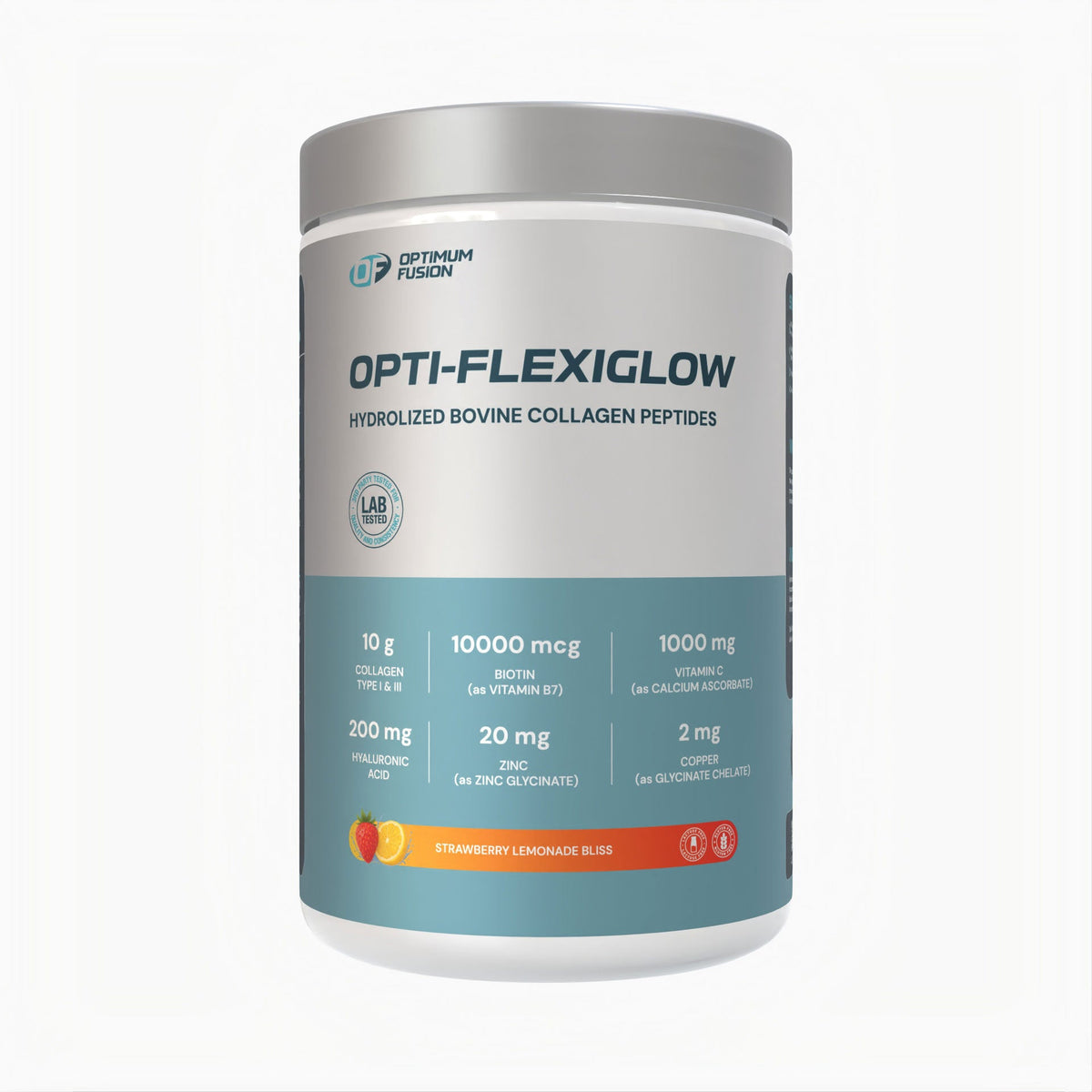
Opti-Flexiglow is built around the same ideas covered above.
What's in each serving:
- 9.44 g hydrolyzed bovine collagen peptides (Type I & Type II)
- Hyaluronic acid
- Vitamin C
- Zinc
- Biotin
- 45 servings per container
- Third-party lab tested
- Halal certified
Who it suits:
- Lifters, runners, padel and football players who load tendons and joints hard
- Athletes returning to training who are doing tendon-loading exercises
- Anyone wanting skin support alongside their training
- Gym-goers who want collagen and vitamin C in one scoop instead of two products
How to use it: take one serving 30–60 minutes before training on gym days, and at any convenient time on rest days. Keep taking your normal complete protein for muscle growth. Follow the label directions.
Health note: Opti-Flexiglow is made from bovine collagen. If you're pregnant, breastfeeding, under 18, have a medical condition, or take medication, speak to your doctor before starting any new supplement. Persistent joint or tendon pain needs a proper assessment from a doctor or physiotherapist.
Frequently Asked Questions
How much collagen should an athlete take per day?
Most studies use 10–15 g of collagen peptides per day. For tendon support, the best-known protocol pairs about 15 g with vitamin C, taken 30–60 minutes before a short bout of loading exercise, while skin studies often use smaller doses of 2.5–10 g daily.
When is the best time to take collagen?
For tendons and ligaments, take it 30–60 minutes before training or rehab exercises so amino acid levels peak while the tissue is under load. On rest days, the timing matters much less, so take it whenever you'll remember.
Why take vitamin C with collagen?
Vitamin C is needed for the enzymes that build and stabilise new collagen in your body. That's why the Shaw et al. (2017) study paired gelatin with vitamin C, and why many formulas include it.
Can collagen replace whey protein?
No. Collagen is not a complete protein because it lacks tryptophan and is low in leucine, so it is weak at building muscle on its own. Use whey or other complete proteins for muscle growth, and collagen as an additional tool for connective tissue and skin.
How long does collagen take to work?
Skin changes may appear after about 8–12 weeks, while joint and tendon studies usually run for 3–6 months. Connective tissue adapts slowly, so daily consistency is more important than any single dose.
Is collagen safe for athletes?
Collagen peptides are generally well tolerated, and occasional mild stomach upset is the most common complaint. Choose a third-party tested product, and speak to a doctor first if you are pregnant, under 18, have a medical condition, or take medication.
The Bottom Line
Collagen peptides for athletes work best as a targeted tool: around 10–15 g daily, with vitamin C, taken 30–60 minutes before loading your tendons. They support connective tissue and skin, but they don't replace complete protein for muscle. Try Opti-Flexiglow alongside a solid protein plan, set your daily targets with our free macro calculator, and see our post workout recovery supplements guide for the rest of your recovery routine.
Share:
Strongest Pre Workout UAE: High-Stim Guide & Caffeine Limits
Pre Workout for Night Training: Sleep-Friendly Guide (UAE)