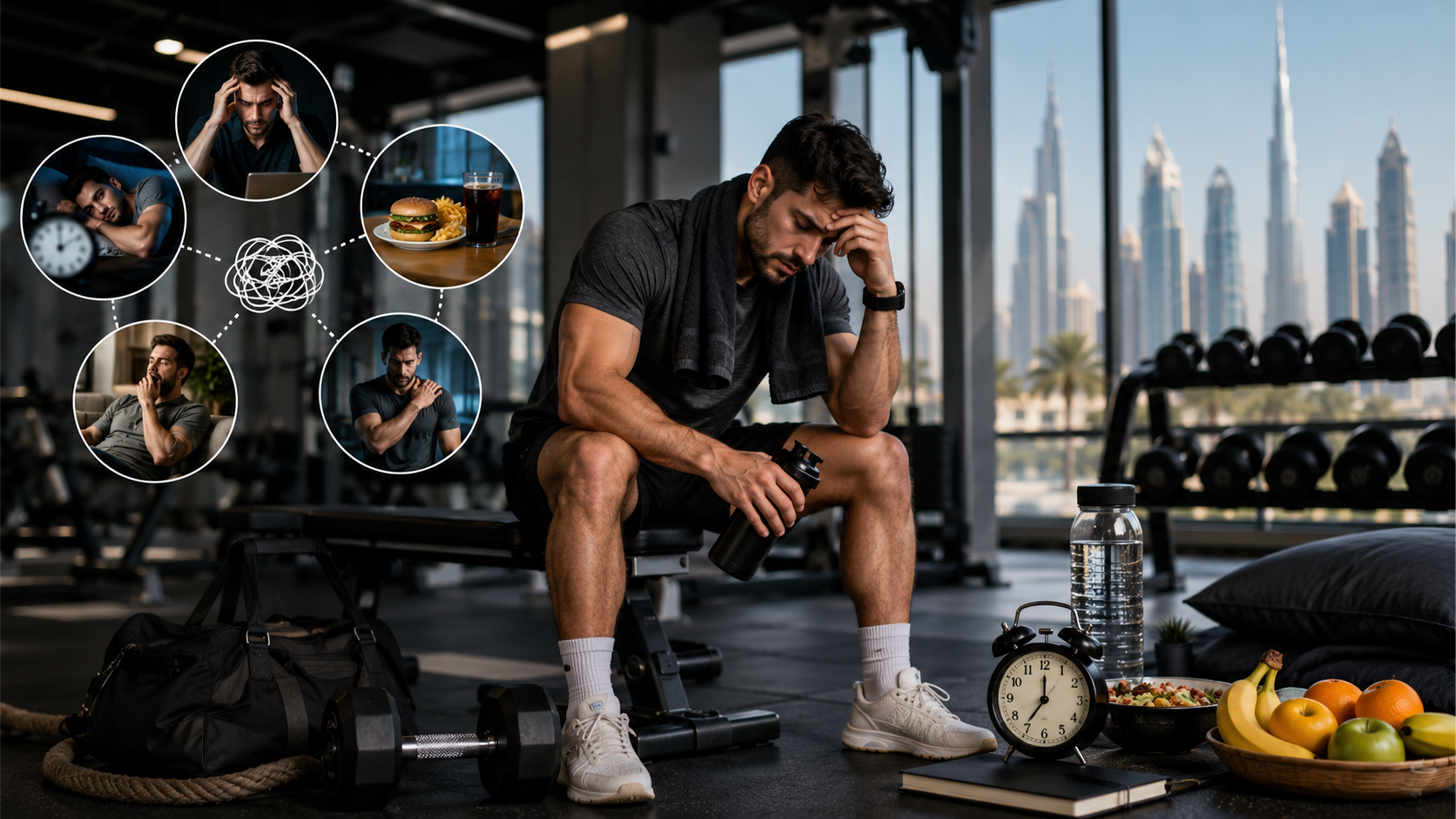
Quick Answer: Why You Feel Tired at the Gym
- Poor nutrition timing — not enough carbs or calories before training
- Dehydration — especially critical in UAE heat
- Low sleep quality — less than 7 hours kills energy and recovery
- Overtraining — too much volume, not enough rest
- Iron or vitamin deficiency — very common in UAE population
- Low ATP availability — muscles can't regenerate energy fast enough
- High stress / cortisol — drains you before you even start[/info]
Most gym fatigue in UAE is fixable within 1–2 weeks once the root cause is identified.

You show up to the gym. You warm up. But 15 minutes in, you're already running on empty — weights feel heavier than usual, focus is scattered, and you're counting down to leave. Sound familiar?
Feeling tired at the gym occasionally is normal. Feeling drained every single session? That's your body flagging something specific — and the answer is rarely "just push harder."
I've worked with gym-goers across Dubai, Abu Dhabi, and Sharjah for years, and chronic low energy during workouts is one of the most common complaints I hear. The good news: it's almost always fixable once you find the actual cause. If you're also struggling with muscle gains alongside energy issues, check out our guide on why you're not gaining muscle even after gym — the two problems are often connected.
Is It Normal to Feel Tired During a Workout?
Some fatigue during training is expected — your body is depleting glycogen, producing lactic acid, losing electrolytes, and challenging your nervous system. Feeling effort is the point.
What's not normal is:
- Feeling exhausted before your workout properly starts
- Consistently running out of energy within 15–20 minutes
- Feeling weaker week over week despite consistent training
- Low energy both inside and outside the gym
- Dreading sessions you actually want to do
These are signs of chronic gym fatigue — and they have specific, addressable causes.
7 Real Reasons You're Always Tired at the Gym — And How to Fix Each
1. You're Not Fuelling Before Training
The most common cause of low energy during workouts — and the most overlooked. Your muscles run on glycogen (stored carbohydrate) during resistance and high-intensity training. Arrive with depleted glycogen and you're driving on an empty tank, no matter how motivated you are.
This is especially common in UAE when athletes:
- Train directly after work without eating since lunch
- Follow low-carb diets while training hard
- Train fasted in the morning without any pre-workout nutrition
- Skip suhoor and train in the morning during Ramadan
The fix: Eat a balanced meal 2–3 hours before training — carbohydrates and protein. Within an hour? A banana and a whey isolate shake is enough. Never train more than 4–5 hours after your last meal without a snack.
💡 Real example: Some of the biggest energy improvements I've seen came from athletes who trained 6+ hours after lunch, directly after work. Same programme, same sleep, same supplements — just adding a shake and a banana 45 minutes before their session made an immediate difference.
2. Dehydration — Amplified by UAE Heat
Even mild dehydration of just 2% body weight drops physical performance by up to 20%. If you've ever felt unusually drained just walking from your car into the gym on a July afternoon, that heat load carries directly into your session.

Many UAE gym-goers are chronically under-hydrated — sitting in strong air conditioning all day (which quietly dehydrates you), then stepping into an intense evening session without compensating.
Signs you're training dehydrated: headache during training, muscle cramps, dark yellow urine before your session, dizziness during cardio.
UAE hydration targets for gym-goers:
- Daily baseline: 3.5–4.5 litres — significantly more than standard global recommendations
- Pre-workout: 500ml in the 30–60 minutes before training
- During training: 200–300ml every 15–20 minutes
- For sessions over 60 minutes: add electrolytes (sodium, potassium, magnesium)
3. Poor Sleep
If one factor destroys gym energy more than anything else, it's insufficient sleep. During deep sleep, your body releases growth hormone, repairs muscle tissue, and resets your nervous system. Short-change sleep and every rep, every set takes noticeably more effort than it should.

Research in Sleep journal found athletes sleeping fewer than 6 hours showed significantly higher perceived exertion and reduced strength output compared to those sleeping 8+ hours — with identical training loads.
UAE-specific sleep challenges: late-night social culture, Ramadan schedule disruptions, heat affecting sleep quality, high-pressure work environments.
The fix: Target 7–9 hours consistently. Keep your bedroom at 18–20°C — UAE bedrooms that stay warm cause lighter, less restorative sleep. No caffeine or pre-workout within 5–6 hours of sleep.
4. Overtraining
In Dubai's gym culture, where training six days a week is almost a social identity, overtraining is extremely common — especially among motivated intermediate athletes who assume more sessions equal faster results.
Overtraining syndrome occurs when training stress consistently exceeds your capacity to recover. The paradox: the harder you train, the worse you perform, because your body never fully repairs.
| Symptom | Normal Training Fatigue | Overtraining |
|---|---|---|
| Energy levels | Tired after sessions, fine between | Chronically low all day |
| Performance | Stable or improving | Declining week over week |
| Mood | Normal | Irritable, unmotivated |
| Resting heart rate | Normal | Elevated by 5–10 BPM consistently |
| Soreness | 48–72 hours, specific muscles | Persistent, general, never fully resolves |
The fix: Allow 48–72 hours between sessions for the same muscle group. Limit intense sessions to 4–5 per week. Schedule a deload week every 6–8 weeks. Opti-Guard (L-glutamine) and Opti-Marine (omega-3) directly support faster recovery between sessions.
5. Iron and Micronutrient Deficiencies
Iron deficiency is one of the leading causes of persistent gym fatigue — and it's particularly common in the UAE. Iron is essential for oxygen delivery to working muscles. Low iron means earlier fatigue, reduced endurance, and that heavy-legged feeling even on easy sessions.
Highest risk groups in UAE: women with heavy menstrual cycles, South Asian vegetarians and vegans, heavy trainers (exercise increases iron losses through sweat), and those with gut absorption issues.
Other deficiencies to check:
- Vitamin D — UAE paradox: despite year-round sun, indoor lifestyle creates widespread deficiency. Low Vitamin D directly impairs muscle function
- Magnesium — lost heavily through sweat in UAE summers, essential for cellular energy production
- B12 — critical for energy metabolism and nervous system function
The fix: Get a full blood panel at least once a year — CBC, iron studies, Vitamin D, B12, magnesium. Walk-in clinics across Dubai and Abu Dhabi make this easy and affordable. Address gaps through diet and targeted supplementation. Optimum Fusion's general health range covers many of these micronutrient gaps.
6. Low ATP — Why Your Muscles Hit the Wall Mid-Session
Your muscles don't directly burn food for energy — they run on ATP (adenosine triphosphate). Every contraction needs it. When ATP depletes faster than your body can regenerate it, you hit that familiar "wall" mid-workout.

For high-intensity gym training, the phosphocreatine system is what rapidly regenerates ATP between sets. Most people have sub-optimal creatine stores — meaning their ATP regeneration is slower than it could be. This shows up as earlier fatigue and that drained feeling 20–30 minutes into a session.
The fix: Opti Charge ATP by Optimum Fusion is built specifically around this — increasing phosphocreatine stores so ATP regenerates faster during training. A daily dose of 3–5g is all it takes, and results are typically noticeable within 3–4 weeks.
💡 Worth knowing: Creatine is the most research-backed performance supplement in existence. Many UAE gym-goers still avoid it based on myths about water retention or kidney damage — neither is supported by evidence at standard doses. If you're consistently tired mid-workout, this is often the most impactful single addition you can make.
7. High Stress and Elevated Cortisol
Chronic stress — work pressure, long Dubai commutes, financial load, social obligations eating into sleep — raises cortisol, your body's primary stress hormone. Elevated cortisol directly suppresses testosterone and growth hormone, the drivers of performance and recovery.
The result: you feel exhausted before your session even starts. Not because you're unfit, but because your nervous system has been in low-grade overdrive all day.
The fix: 10–15 minutes of morning breathwork measurably lowers cortisol. Protect sleep above all else — it's the primary regulator. Opti-Marine (omega-3) reduces systemic inflammation and helps regulate cortisol response. Schedule at least one complete rest day each week — physically and mentally.
UAE-Specific Factors That Make Gym Fatigue Worse
Training in UAE Summer
When it's 42°C outside and your gym's air conditioning is fighting the heat, your cardiovascular system works harder just to keep your body temperature stable — before you've even touched a weight. Perceived exertion is legitimately 20–30% higher in peak summer months. This isn't weakness; it's physics.

Adjust expectations in summer: increase hydration targets to 4–5 litres daily, train during cooler hours where possible, and reduce session intensity. Maintaining quality over these months beats burning out and stopping entirely.
Gym Energy During Ramadan
Fasting from suhoor to iftar compresses your nutrition and hydration window dramatically. The most common mistake: keeping the same programme intensity without adjusting for fundamentally different energy availability.
- Train post-iftar — 60–90 minutes after — when glycogen is replenished
- Reduce intensity by 20–30%. Ramadan is a maintenance phase, not a progress phase
- A whey isolate shake at suhoor provides amino acid availability through the fast
- Stay maximally hydrated between iftar and suhoor
Supplement Stack for UAE Gym Fatigue
| Problem | Product | How It Helps |
|---|---|---|
| Mid-session energy crash | Opti Charge ATP | Faster ATP regeneration = more sustained energy through the session |
| Weak pre-workout energy | Opti-911 | Focus, blood flow, and sustained energy without the crash |
| Poor session-to-session recovery | Opti-Guard | L-glutamine for faster recovery so your next session starts fresher |
| Inflammation and cortisol | Opti-Marine | Omega-3 reduces systemic inflammation and supports cortisol regulation |
| Muscle fuel and repair | Opti Isolate | Whey protein for muscle repair and amino acid availability |
Frequently Asked Questions
Why do I feel tired at the gym even though I sleep well?
If you sleep well but still feel tired at the gym, the most common causes are poor nutrition, dehydration, low iron or Vitamin D, and inadequate recovery. In the UAE, chronic dehydration is especially common due to heat and air conditioning.
Why do I run out of energy so quickly during workouts?
Running out of energy quickly during workouts usually happens because of low glycogen, dehydration, or low ATP availability. Eating carbs before training, staying hydrated, and using creatine can improve workout energy and endurance.
Is it normal to feel tired during a workout?
Mild tiredness during workouts is normal. Constant exhaustion, poor performance, or long recovery times may indicate overtraining, poor sleep, dehydration, or nutritional deficiencies.
What should I eat before the gym to avoid fatigue?
Eat carbohydrates and protein 2–3 hours before training. Good pre-workout foods include rice, oats, eggs, bananas, dates, or a whey protein shake for quick workout energy.
Why do I feel more tired at the gym during UAE summer?
UAE summer heat increases dehydration and physical stress during exercise, making workouts feel harder. Drinking more water, adding electrolytes, and training during cooler hours can help reduce fatigue.
Why do I feel exhausted after the gym the next day?
Next-day fatigue is usually caused by poor recovery, low protein intake, dehydration, or excessive training volume. Better sleep, hydration, and post-workout nutrition can improve recovery speed.
Can dehydration cause fatigue during workouts?
Yes. Even mild dehydration can reduce strength, endurance, and focus during workouts. In hot climates like the UAE, dehydration is one of the biggest causes of gym fatigue.
Can creatine help reduce gym fatigue?
Yes. Creatine helps muscles regenerate ATP faster, improving workout performance, strength, and energy during high-intensity training.
Fix the Root Cause, Not the Symptom
Feeling tired at the gym is not a motivation problem — it's a physiology problem. And physiology problems have specific, fixable causes.
Work through the seven causes above systematically. Most UAE gym-goers who address nutrition timing, hydration, sleep quality, and supplement gaps see clear improvements within two to three weeks — without changing their programme at all.
Start with the basics: eat before you train, drink more water than you think you need, protect your sleep. Opti Charge ATP and Opti-911 are the two most directly impactful products for in-gym energy — both available with UAE-wide delivery from optimumfusion.ae.
Train smart. Recover properly.
This article is based on sports science research, practical coaching experience with UAE athletes, and 2026 fitness data. Always consult a qualified healthcare professional if you experience persistent fatigue that may indicate an underlying medical condition.
Share:
How to Recover Faster After Workout in UAE (2026 Guide)
Best Supplements for Skinny Guys to Gain Weight UAE (2026)