




Last updated: October 2026 · By the OptimumFusion Team
Quick answer: Most adults get about 250–500 mg of EPA + DHA per day only if they eat oily fish such as salmon, sardines or mackerel around twice a week. A 150 g portion of salmon gives roughly 2–3 g of EPA + DHA, while the same amount of hammour or tilapia gives only about 0.2–0.4 g. If you rarely eat oily fish, one fish oil softgel with 800 mg of EPA + DHA can cover your daily target in a few seconds.
Key Takeaways
- What counts is EPA + DHA, not the total "fish oil" or "omega-3" number on a menu or label.
- Oily fish (salmon, sardines, mackerel) carry roughly 5–10 times more EPA + DHA than popular white fish in the UAE such as hammour or tilapia.
- Common reference intakes sit around 250–500 mg EPA + DHA per day for healthy adults; many lifters aim for the higher end.
- If you eat two portions of oily fish per week, you may not need a supplement; if you eat fish once a month, a softgel is the simpler route.
- In UAE heat, storage matters: keep fish oil cool and out of a parked car, because heat speeds up oxidation.
Why EPA and DHA Are the Numbers That Matter
"Omega-3" is a family of fats. The two forms that most research on training, recovery and general wellbeing focuses on are EPA (eicosapentaenoic acid) and DHA (docosahexaenoic acid). Both are found mainly in seafood.
Plant foods such as flaxseed, chia and walnuts contain a different omega-3 called ALA. Your body can convert some ALA into EPA and DHA, but the conversion is small — usually only a few percent. That is why a handful of chia seeds is not a direct swap for a portion of salmon.
How much do you actually need? There is no single official number for gym-goers, but a few reference points are widely used:
- The European Food Safety Authority (EFSA) set an adequate intake of 250 mg EPA + DHA per day for adults.
- The American Heart Association recommends eating fish, especially oily fish, about twice per week.
- Many sports nutrition reviews discuss intakes of around 1–2 g EPA + DHA per day for athletes, while noting that the evidence for performance benefits is still mixed.
For a male lifter training 3–5 days a week in Dubai or Abu Dhabi, a practical goal is at least 500 mg EPA + DHA per day on average, from food, a supplement, or both. If you want to see how omega-3 fits into a wider plan, read our Omega 3 for Athletes guide.
How Much Omega-3 Is in Fish You Can Buy in the UAE?
Here is the core comparison. Values are approximate EPA + DHA per 150 g cooked portion, based on typical food composition data. Real numbers vary with species, season, farmed vs wild, and cooking method.
| Fish (150 g cooked) | Common in UAE as | Approx. EPA + DHA | Days of a 500 mg/day target |
|---|---|---|---|
| Atlantic salmon (farmed) | Imported fillets, sushi | 2.5–3.0 g | 5–6 days |
| Mackerel | Imported, canned | 1.5–2.5 g | 3–5 days |
| Sardines (canned in oil, drained) | Supermarket cans | 1.3–1.6 g | 2–3 days |
| Tuna, canned white (albacore) | Supermarket cans | 1.0–1.3 g | 2 days |
| Kingfish (kanaad) | Local fish markets | 0.5–0.8 g | 1–1.5 days |
| Tuna, canned light | Supermarket cans | 0.3–0.4 g | Less than 1 day |
| Hammour (grouper) | Restaurants, markets | 0.3–0.4 g | Less than 1 day |
| Shrimp | Restaurants, frozen | 0.3–0.5 g | Less than 1 day |
| Tilapia | Frozen fillets | 0.15–0.25 g | Less than half a day |
The pattern is clear: oily, darker fish win by a wide margin. Hammour, shrimp and tilapia are excellent lean protein sources, but they do not move your omega-3 intake much. A lifter who eats grilled hammour three times a week might feel he is "eating plenty of fish" and still fall short of 500 mg per day on average.
Frying also changes the picture. Deep-fried fish soaks up cooking oil, which adds omega-6 fats and calories without adding EPA or DHA. Grilling, baking or steaming keeps the fish's own fats intact.
Fish Oil vs Eating Fish: Side-by-Side
Neither option is "better" in every way. Whole fish gives you more than omega-3, while a softgel gives you a fixed, convenient dose.
| Factor | Eating oily fish | Fish oil softgel |
|---|---|---|
| EPA + DHA per serving | Varies widely (0.2–3 g per 150 g) | Fixed and printed on the label |
| Protein | 30–35 g per 150 g portion | None |
| Other nutrients | Vitamin D, selenium, iodine, B12 | Mainly EPA + DHA |
| Calories | 200–350 kcal per portion | About 9–10 kcal per 1 g softgel |
| Convenience | Cooking or eating out needed | Seconds, with any meal |
| Cost per week | Higher for salmon in UAE supermarkets | Usually lower per gram of EPA + DHA |
| Mercury | Depends on species | Purified oils are routinely tested |
| Weekly consistency | Easy to skip on busy weeks | Easy to keep daily |
The US Food and Drug Administration advises choosing lower-mercury fish more often and limiting high-mercury species such as king mackerel, shark and swordfish. Smaller oily fish such as sardines and salmon are generally lower in mercury, which is another reason they are smart picks.
Our view: food first, supplement to fill the gap. If your diet is mostly chicken, beef, rice and the occasional hammour, a softgel is the most reliable way to reach your target.
Weekly Omega-3 Plans for UAE Lifters
Below are three simple setups, each aiming for an average of roughly 500–800 mg EPA + DHA per day (3.5–5.6 g per week).
| Plan | What you eat | Supplement | Approx. weekly EPA + DHA |
|---|---|---|---|
| Fish lover | 2 × 150 g salmon + 1 can sardines | None needed | 6–7.5 g |
| Mixed | 1 × 150 g salmon | 1 softgel on 4 days | 5.7–6.2 g |
| Busy / low fish | Mostly chicken and beef | 1 softgel daily | 5.6 g |
UAE tips that make this easier:
- Sardines and canned salmon are cheap, shelf-stable and need no cooking — useful after a late session in summer when nobody wants to stand at a hot stove.
- During Ramadan, take your softgel with suhoor or iftar alongside a meal that contains some fat; this supports absorption and may reduce "fishy burps."
- In summer, never leave fish oil in your car or gym bag. Cabin temperatures in Dubai and Abu Dhabi can climb above 60°C, which speeds up oxidation of the oil.
- Pair omega-3 with enough protein. An 80 kg lifter targeting 1.6–2.2 g per kg needs about 130–175 g protein per day; our high protein diet plan for beginners shows how to build that around UAE meals.
Oily fish also supply vitamin D, which many people in the region still run low on despite the sun — our vitamin D for athletes in the UAE guide explains why.
Opti-Marine Omega 3: A Simple Way to Fill the Gap
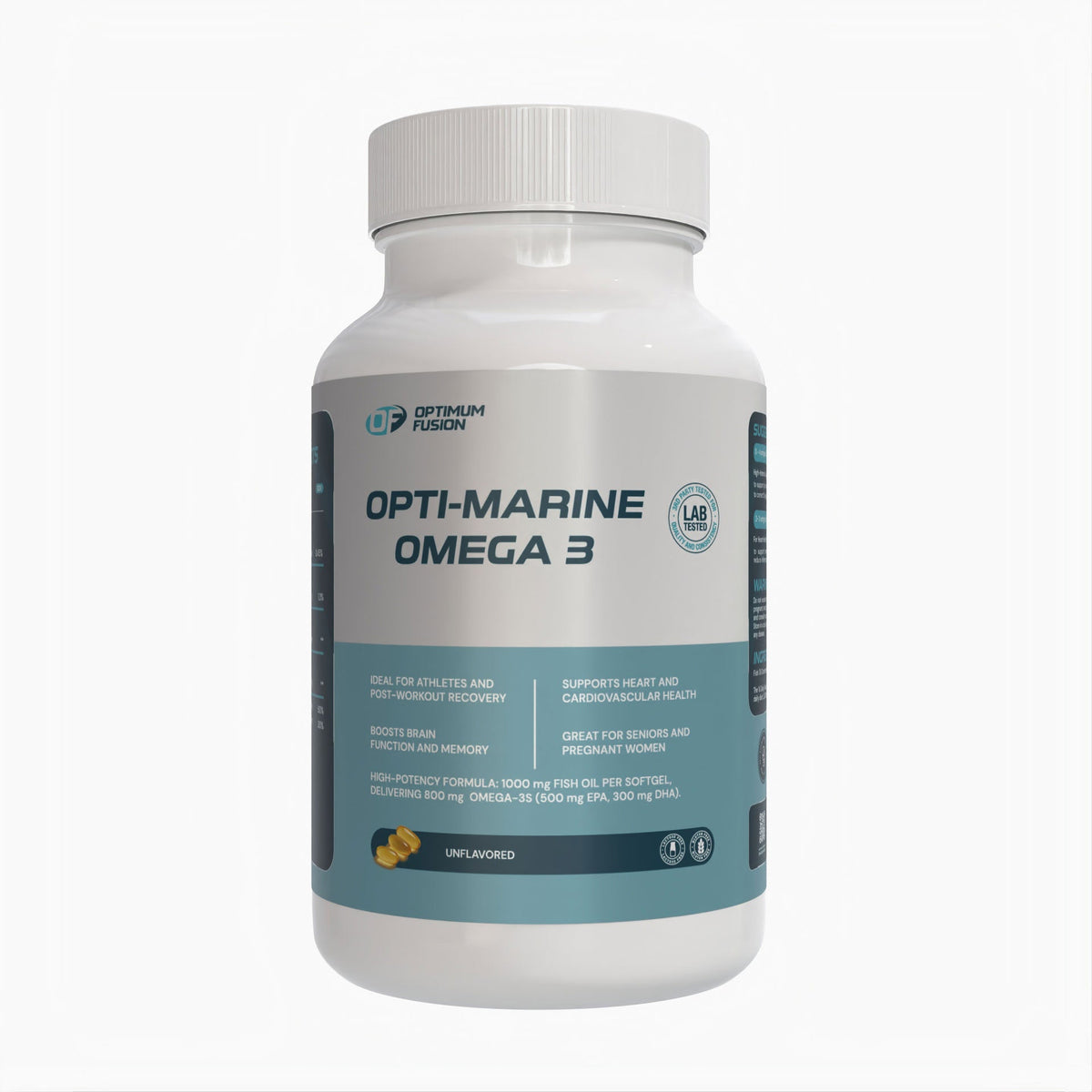
Opti-Marine Omega 3 is built for lifters who do not eat oily fish often enough. Each 1000 mg fish oil softgel provides 500 mg EPA + 300 mg DHA, a total of 800 mg EPA + DHA in one softgel. That is above the EFSA reference of 250 mg per day and close to the amount in a 50 g piece of salmon.
| Opti-Marine per softgel | Amount |
|---|---|
| Fish oil | 1000 mg |
| EPA | 500 mg |
| DHA | 300 mg |
| Total EPA + DHA | 800 mg |
| Softgels per bottle | 100 |
Opti-Marine is halal certified and third-party lab tested, with fast delivery across the UAE. Take one softgel daily with a meal; on days you eat a full portion of salmon or sardines, you can skip it. With 100 capsules, one bottle lasts over three months at one per day.
It supports your overall nutrition alongside training, protein and sleep — it does not replace them. See Opti-Marine Omega 3 here.
Health note: Speak to your doctor before using fish oil if you take blood-thinning or blood pressure medication, have a seafood allergy, have a medical condition, or have surgery planned. Not intended for anyone under 18.
Frequently Asked Questions
Is eating fish better than taking fish oil?
Eating oily fish gives you protein, vitamin D, selenium and iodine as well as EPA and DHA, so it is a great first choice. Fish oil is better for consistency and a fixed dose. Many lifters in the UAE combine both: oily fish once or twice a week and a softgel on the other days.
How much salmon do I need per week to get enough omega-3?
About two 150 g portions of salmon per week provide roughly 5–6 g of EPA + DHA, which averages around 700–850 mg per day. That meets common reference intakes for healthy adults without a supplement.
Does hammour have a lot of omega-3?
Not much. A 150 g portion of hammour provides roughly 0.3–0.4 g of EPA + DHA, far below salmon or sardines. Hammour is an excellent lean protein, but it should not be your main omega-3 source.
When is the best time to take fish oil?
Take it with a meal that contains some fat, at any time of day. Timing around your workout does not appear to matter much; daily consistency matters more. During Ramadan, suhoor or iftar both work well.
Can fish oil go bad in the UAE heat?
Yes. Heat, light and air speed up oxidation, which can give the oil a strong smell and taste. Store your bottle in a cool cupboard away from the stove, keep the lid closed, and never leave it in a parked car during summer.
Can I take fish oil with creatine and protein?
Yes. Omega-3, creatine and protein do different jobs and are commonly taken together. Many lifters take a softgel with the meal that follows their shake. Check with your doctor first if you take any regular medication.
The Bottom Line
For most lifters, the gap is not "omega-3 vs no omega-3" — it is oily fish vs white fish. Salmon, sardines and mackerel deliver several grams of EPA + DHA per portion, while hammour, shrimp and tilapia deliver very little. If you eat oily fish twice a week, you are likely covered; if not, one Opti-Marine Omega 3 softgel with 800 mg EPA + DHA closes the gap simply.
Get your full daily protein, carbs and fat with our free protein and macro calculator, then read how to recover faster after workouts in the UAE and our Omega 3 for Athletes guide to build the rest of your plan.
Share:
Cardio and Muscle Loss: How to Do Cardio Without Losing Gains
Glutamine and Gut Health for Athletes: What Research Says (UAE)