




Last updated: September 2026 · By the OptimumFusion Team
Quick answer: For omega 3 for athletes, research most often uses 1–3 g of combined EPA + DHA per day, and some studies suggest this range may help reduce muscle soreness and support recovery. Most people eating little oily fish get far less than that. When choosing fish oil, check the EPA + DHA per capsule, not the total oil: a "1,000 mg" softgel may contain only 300 mg of actual omega-3s. Take it with a meal, and talk to a doctor first if you use blood thinners.
Key Takeaways
- EPA and DHA are the omega-3s that matter for athletes. They come mainly from fish and seafood.
- Studied doses for recovery are usually 1–3 g of EPA + DHA daily for several weeks.
- Research suggests modest benefits for soreness and strength recovery after hard training, not dramatic ones.
- Many UAE diets are low in oily fish, even with plenty of seafood available.
- Read the label carefully: EPA + DHA content per capsule is what counts.
EPA vs DHA: What's the Difference?
Omega-3s are essential fats, meaning your body can't make enough on its own. There are three main types:
- ALA (alpha-linolenic acid) from plant foods like flax, chia, and walnuts
- EPA (eicosapentaenoic acid) from fish and seafood
- DHA (docosahexaenoic acid) from fish and seafood
Your body converts only a small percentage of ALA into EPA, and even less into DHA. That's why fish and fish oil are the most direct sources.
| Feature | EPA | DHA |
|---|---|---|
| Main role | Involved in the body's inflammatory response and resolution | Structural fat in brain, eyes, and cell membranes |
| Athlete interest | Recovery, soreness, joint comfort | Brain and nervous system, reaction time research |
| Found in | Oily fish, fish oil | Oily fish, fish oil, algal oil |
| Typical fish oil ratio | Often higher than DHA | Often lower than EPA |
For recovery, most research uses formulas with more EPA than DHA, though both matter for overall health.
Doses Studied in Athletes
| Goal in research | EPA + DHA per day | Duration |
|---|---|---|
| General health baseline | 250–500 mg | Ongoing |
| Muscle soreness and recovery | 1–3 g | 2–8 weeks |
| Muscle protein synthesis (older adults) | About 4 g | 8 weeks |
| Limiting muscle loss during immobilisation | About 5 g | Several weeks |
Reference points:
- The European Food Safety Authority (EFSA) set an adequate intake of 250 mg EPA + DHA per day for general health in adults.
- EFSA's 2012 opinion concluded that supplemental intakes of up to 5 g per day of combined EPA + DHA don't raise safety concerns for adults.
- The American Heart Association recommends about two servings of fish per week, preferably oily fish.
Omega-3s build up in cell membranes gradually, so benefits in studies usually appear after several weeks of daily use, not after one dose.
What Research Says About Recovery and Soreness
Delayed onset muscle soreness (DOMS) is the stiffness you feel 24–72 hours after a new or hard workout. Several studies have looked at whether omega-3s make it easier.
- A study by Tartibian and colleagues in the Clinical Journal of Sport Medicine (2009) found that untrained men taking 1.8 g of omega-3 per day reported less soreness and better range of motion after eccentric exercise.
- A study by Jouris and colleagues in the Journal of Sports Science and Medicine (2011) found reduced soreness after biceps exercise with a daily fish oil supplement.
- A 2019 review by Philpott and colleagues in Research in Sports Medicine concluded that omega-3s may help reduce soreness and support recovery of muscle function, while noting that study sizes are small and results vary.
Muscle mass research is interesting but mostly in specific groups. Smith and colleagues (American Journal of Clinical Nutrition, 2011) found about 4 g per day enhanced the muscle-building response to protein in older adults. Work by McGlory and colleagues suggested omega-3s may help limit muscle loss during leg immobilisation. Effects in young, well-fed lifters are less clear.
Realistic expectation: fish oil won't replace protein, sleep, or smart programming. It's a supporting player for recovery and overall health. For joint-focused options, see our guide to supplements for healthy joints.
Fish Intake in the UAE Diet
The UAE has a long fishing tradition, and hammour, safi, sheri, and kingfish (kanaad) are familiar favourites. But many popular local fish are lean white fish, which are excellent protein sources yet relatively low in omega-3s compared with oily fish.
| Fish (approx. per 100 g cooked) | EPA + DHA |
|---|---|
| Salmon (farmed) | About 1.5–2.0 g |
| Mackerel | About 1.0–2.0 g |
| Sardines | About 1.0 g |
| Kingfish / tuna steak | About 0.2–0.5 g |
| Hammour (grouper) | About 0.2–0.3 g |
| Canned light tuna | About 0.2–0.3 g |
Values vary with species, season, and farming method, so treat these as rough guides.
Common gaps for UAE gym-goers:
- Meals built around chicken, beef, eggs, and rice with little oily fish
- Fish eaten fried, which adds calories without changing omega-3 content much
- Busy schedules and food delivery replacing home-cooked meals
If you eat salmon, sardines, or mackerel twice a week, you're likely meeting basic intake. If you rarely do, and you train hard, a fish oil supplement can help close the gap.
How to Choose a Fish Oil Supplement
The biggest mistake is reading "1,000 mg fish oil" on the front and assuming that's 1,000 mg of omega-3. Many standard fish oils contain only about 180 mg EPA + 120 mg DHA per 1,000 mg softgel, which is 300 mg of actual omega-3s.
Checklist:
- Check EPA + DHA per capsule on the back label, not the total oil weight
- Count capsules per serving. Some products list a "serving" as 2 or 3 softgels
- Look for concentrated oils so you need fewer capsules to reach your target
- Third-party lab tested for purity and contaminants such as heavy metals
- Freshness: a strong fishy smell when you open the bottle can signal oxidation
- Store it well: keep it away from heat and direct sun; a hot car in Dubai is not a good place
Take fish oil with a meal containing fat. Absorption is better, and it reduces the chance of fishy burps.
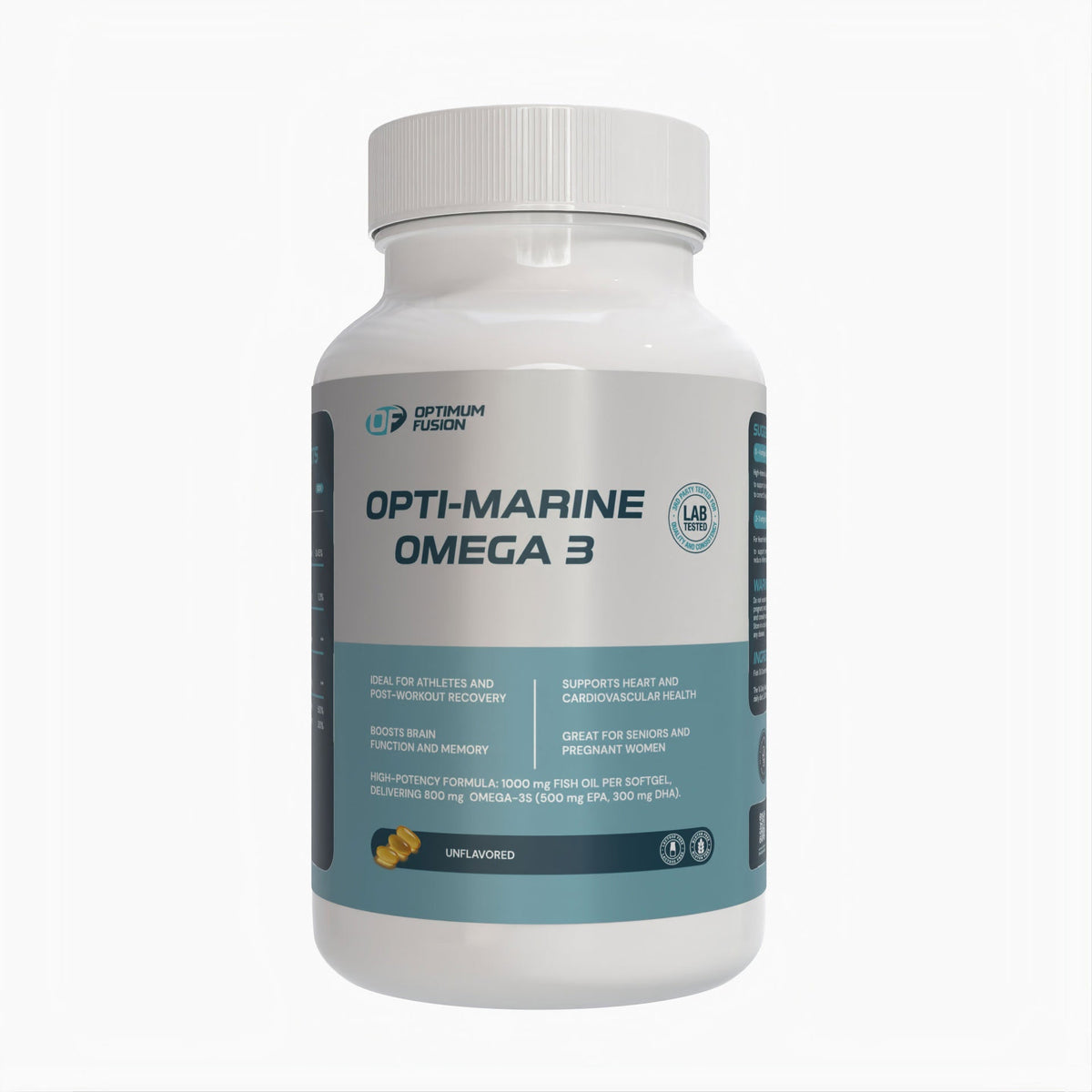
Opti-Marine: Concentrated Omega-3
Opti-Marine is a concentrated fish oil, so each softgel delivers a high amount of the omega-3s that matter.
What's in each capsule:
- 1,000 mg concentrated fish oil
- 800 mg omega-3, including 500 mg EPA + 300 mg DHA
- 100 capsules (100 days at 1 capsule per day)
- Third-party lab tested
- Halal certified
Who it suits:
- Gym-goers who rarely eat oily fish
- Athletes in high-volume training who want to support recovery
- Anyone who wants a higher EPA + DHA dose in fewer capsules
How to use it:
- Everyday baseline: 1 capsule daily with a meal gives 800 mg of omega-3
- Heavy training phases: some people use 2 capsules daily (1,600 mg omega-3), in line with the lower end of amounts studied for soreness. Check with your doctor if you plan to go higher.
For a simple health foundation, pair it with a daily multivitamin such as Opti-Ultra, and see where both fit in our beginner supplement stack guide. Why third-party testing matters is covered in third-party tested supplements in the UAE. Shop Opti-Marine here.
Health note: omega-3s can affect blood clotting. If you take blood thinners or anti-platelet medication (such as warfarin or aspirin), have a bleeding disorder, have surgery scheduled, are pregnant or breastfeeding, have a fish or shellfish allergy, or are under 18, talk to your doctor before taking fish oil.
Frequently Asked Questions
How much omega 3 should athletes take?
Research on recovery and soreness commonly uses 1–3 g of combined EPA and DHA per day for several weeks. For general health, around 250–500 mg per day is a common baseline, and your doctor can help decide on higher amounts.
Is EPA or DHA better for athletes?
Both matter, but recovery research has mostly used formulas with more EPA than DHA. DHA is more linked to brain and eye structure, so a combined EPA and DHA product covers both roles.
Does fish oil reduce muscle soreness?
Several small studies suggest that daily omega-3 supplementation may reduce soreness and support strength recovery after hard or unfamiliar exercise. The effects are modest and usually appear after a few weeks of consistent use.
When should I take fish oil?
Take it with a meal that contains some fat, at any time of day that you can stay consistent with. Taking it with food improves absorption and reduces fishy aftertaste.
Can I get enough omega 3 from eating fish?
Yes, if you eat oily fish such as salmon, sardines, or mackerel about twice a week. Lean white fish like hammour are great protein sources but contain much less omega-3.
Is fish oil safe with blood thinners?
Omega-3s can affect blood clotting, so anyone taking blood thinners or anti-platelet medication should talk to their doctor before using fish oil. Mention it before any surgery or dental procedure as well.
The Bottom Line
For most gym-goers, omega-3s are a quiet foundation rather than a performance booster: aim for oily fish twice a week or a quality fish oil, and read the EPA + DHA numbers, not the total oil. Set your daily protein and calories with our free macro calculator, and build a complete recovery plan with our guide to post workout recovery supplements.
Share:
Creatine vs Pre Workout: Differences, Timing & Taking Both
Strongest Pre Workout UAE: High-Stim Guide & Caffeine Limits