




Last updated: October 2026 · By the OptimumFusion Team
Quick answer: Whey and collagen do different jobs. For muscle growth, whey wins: a 25–30 g serving delivers roughly 2.5–3 g of leucine and all nine essential amino acids, while collagen is low in leucine and contains no tryptophan. Collagen (around 10–15 g a day, ideally with vitamin C, 30–60 minutes before training) may help support tendons, ligaments and connective tissue. Most male lifters in the UAE are best served by whey as the main protein and collagen as an optional add-on, not a replacement.
Key Takeaways
- Whey is a complete protein; collagen is not, so collagen should not count fully toward your daily muscle-building protein target.
- Leucine is the big difference: whey is about 10–11% leucine, collagen only about 3%.
- Collagen's role is connective tissue support, especially for heavy lifters, runners and padel players training on hard surfaces in Dubai and Abu Dhabi.
- Timing differs: whey after training or between meals; collagen with vitamin C roughly 30–60 minutes before a session.
- Using both is common and sensible if your joints and tendons take a beating and your budget allows it.
Collagen vs Whey: What Is Actually Different?
Both are animal proteins and both come as powders, so it is easy to assume they are interchangeable. They are not. Their amino acid profiles are very different, and that decides what each one is good for.
Whey comes from milk and is rich in the branched-chain amino acids, especially leucine, which acts as the main "on switch" for muscle protein synthesis. Collagen is the structural protein of skin, bone, tendons and ligaments. It is dominated by glycine, proline and hydroxyproline, the building blocks your connective tissue uses.
| Feature (per ~25 g protein) | Whey protein | Collagen peptides |
|---|---|---|
| Complete protein (all 9 EAAs) | Yes | No (no tryptophan) |
| Leucine | ~2.5–3 g | ~0.7 g |
| Glycine + proline + hydroxyproline | Low | Very high (~50% of amino acids) |
| Main use for lifters | Muscle growth and repair | Tendon, ligament and joint support |
| Digestion speed | Fast | Fast (hydrolyzed peptides) |
| Counts toward muscle protein target | Fully | Only partly |
The International Society of Sports Nutrition (ISSN) position stand on protein and exercise highlights leucine content and essential amino acid quality as key drivers of a protein's muscle-building value. On that measure, whey is one of the best options available, and collagen sits near the bottom. That does not make collagen useless; it just means it has a different job.
Which Builds More Muscle?
If your only goal is adding muscle, whey is the clear choice. Studies directly comparing the two, including work from McMaster University's exercise metabolism group, have found that whey stimulates muscle protein synthesis much more strongly than an equal dose of collagen.
There is one interesting exception. A study by Zdzieblik and colleagues, published in the British Journal of Nutrition in 2015, gave older men 15 g of collagen peptides daily alongside resistance training for 12 weeks and reported greater gains in fat-free mass and strength than placebo. That suggests collagen may contribute something when total protein intake is low, but the control group received a placebo, not whey. It does not show collagen beats whey.
For a practical comparison, here is what a typical 80 kg lifter in the UAE might need:
| Body weight | Daily protein target (1.6–2.2 g/kg) | Whey servings to help fill the gap | Collagen add-on (optional) |
|---|---|---|---|
| 70 kg | 112–154 g | 1–2 scoops | 10–15 g |
| 80 kg | 128–176 g | 1–2 scoops | 10–15 g |
| 90 kg | 144–198 g | 2 scoops | 10–15 g |
| 100 kg | 160–220 g | 2–3 scoops | 10–15 g |
The 1.6–2.2 g/kg range reflects the ISSN position stand for people in resistance training. Work out your personal target with our protein calculator for muscle gain, and count collagen as a "bonus" rather than part of that core number.
Where Collagen Earns Its Place
Tendons and ligaments adapt more slowly than muscle. When your strength jumps quickly in the first year or two of lifting, your connective tissue can lag behind, which is one reason elbows, knees and shoulders start complaining.
Research led by Keith Baar and colleagues, published in the American Journal of Clinical Nutrition in 2017 (Shaw et al.), found that taking vitamin C-enriched gelatin about an hour before short bouts of jump-rope exercise increased markers of collagen synthesis. This is why the common protocol is collagen plus vitamin C, taken 30–60 minutes before training.
Collagen may be worth considering if you:
- Lift heavy and train the same joints several times a week
- Play padel, football or run on hard outdoor surfaces in Dubai or Abu Dhabi
- Are over 35 and recovering more slowly between sessions
- Have just increased training volume or returned after a long break
For more on joint-friendly nutrients, see our guide to the top supplements for healthy joints and our deeper dive on collagen peptides for athletes.
How to Take Both: A Simple UAE Routine
Taking whey and collagen together in one shake is fine, but splitting them lets each one do its job. In the UAE heat, also keep fluids up: a hot outdoor session can push sweat losses well over 1 litre per hour.
| Time | What to take | Why |
|---|---|---|
| 30–60 min before training | 10–15 g collagen + vitamin C | Supports connective tissue during loading |
| Within 1–2 hours after training | 25–30 g whey | Leucine-rich protein for muscle repair |
| Between meals (if short on protein) | 1 scoop whey | Helps hit your daily gram target |
| Ramadan, after Iftar | Whey with or after the meal; collagen before a late session | Fits the eating window without overloading Suhoor |
During Ramadan many lifters in the UAE train after Iftar. In that case, take collagen with water about 30–45 minutes before the session and have whey afterwards or at Suhoor. If whey sometimes feels heavy on your stomach, our article on whey isolate vs concentrate explains why isolate is usually lighter and lower in lactose.
Opti FlexiGlow: Collagen Built for Lifters
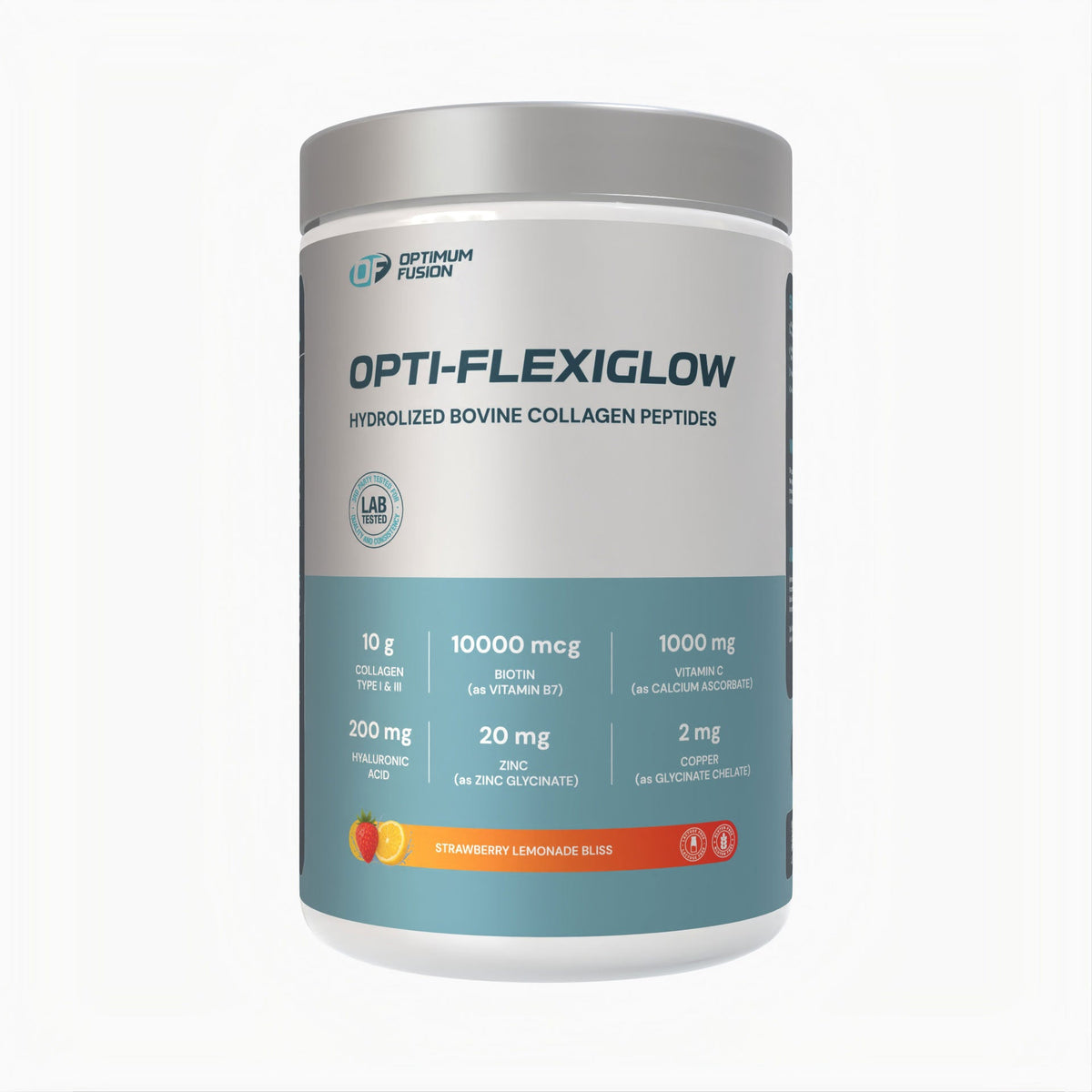
If you decide collagen fits your routine, Opti FlexiGlow is our collagen formula. Each serving provides:
- 9.44 g bovine collagen peptides (Type I & II)
- Vitamin C, the nutrient research pairs with collagen
- Hyaluronic acid
- Zinc and biotin
- 45 servings per tub
Because vitamin C is already in the formula, you can mix one scoop with water 30–60 minutes before training without needing a separate supplement. Opti FlexiGlow is halal certified and third-party lab tested, with fast delivery across the UAE.
Pair it with a complete protein such as Opti Isolate (26.35 g protein per scoop) after training, and you cover both muscle and connective tissue support. You can find full details on the Opti FlexiGlow product page.
Health note: If you take prescription medication, have a medical condition, or are under 18, speak with your doctor before starting any supplement. Collagen supplements are not a substitute for medical care for an injury.
Frequently Asked Questions
Can collagen replace whey protein for building muscle?
No. Collagen lacks tryptophan and is low in leucine, so it is not a complete protein and is much weaker at stimulating muscle protein synthesis. Keep whey or other complete proteins as the base of your diet and treat collagen as an extra.
Should I count collagen toward my daily protein target?
Only partly. Many sports nutritionists recommend counting little or none of it toward your muscle-building target. A simple rule is to hit your 1.6–2.2 g/kg goal from complete proteins first, then add collagen on top.
When is the best time to take collagen?
Research on collagen synthesis used a dose taken with vitamin C roughly 30–60 minutes before exercise. If training at that time is not practical, taking it at the same time every day is a reasonable approach.
Can I mix collagen and whey in the same shake?
Yes. Mixing them is safe and convenient. Splitting them, with collagen before training and whey after, simply matches each to the timing used in research.
How much collagen should a lifter take per day?
Most studies have used about 10–15 g per day. One serving of a collagen product in that range, taken consistently for at least 8–12 weeks, is a sensible starting point.
Is collagen worth it for gym-goers in the UAE?
It may be worth it if you lift heavy, play sports on hard surfaces, or are over 35. If your joints feel fine and your budget is tight, prioritise whey, creatine and enough sleep first, then consider collagen later.
The Bottom Line
Whey and collagen are not rivals; they are teammates. Whey builds and repairs muscle thanks to its leucine and complete amino acid profile, while collagen may help support the tendons and ligaments that carry the load. Start by setting your daily protein target with our protein and macro calculator, fill it with complete protein, and add collagen if your joints need extra support. For more planning help, read our protein calculator guide and collagen peptides for athletes.
Share:
Magnesium and Sleep for Athletes: Dose, Timing & Foods (UAE)
EAA vs BCAA: Which Is Better for Muscle Growth? (UAE Guide)