




Last updated: October 2026 · By the OptimumFusion Team
Quick answer: For most lifters in the UAE, EAAs are the better choice than BCAAs. BCAAs provide only 3 of the 9 essential amino acids, so they can signal muscle growth but cannot fully support it on their own. A 10–15 g EAA serving with at least 2.5–3 g of leucine covers all nine and may help when you train fasted, early in the morning, or in long sessions in Dubai or Abu Dhabi heat. If you already hit about 1.6 g of protein per kg of body weight daily, both are optional extras, not essentials.
Key Takeaways
- BCAAs = 3 amino acids (leucine, isoleucine, valine). EAAs = all 9 essential amino acids, including the three BCAAs.
- Muscle protein synthesis needs every essential amino acid present, so BCAAs alone give an incomplete signal.
- Aim for 2.5–3 g leucine per serving; a 15 g EAA dose usually gets you there.
- EAAs make most sense during or around training when a full protein meal is not practical, such as early fasted sessions or Ramadan training after iftar.
- Total daily protein (roughly 1.4–2.0 g/kg) matters far more than any single amino acid product.
EAA vs BCAA: What Is the Actual Difference?
Your body uses 20 amino acids to build protein. Nine of them are called essential because your body cannot make them; they have to come from food or supplements. These are histidine, isoleucine, leucine, lysine, methionine, phenylalanine, threonine, tryptophan and valine.
BCAAs (branched-chain amino acids) are just three of those nine: leucine, isoleucine and valine. They became popular because leucine acts like a "switch" that tells muscle to start building. EAAs contain all nine, which means they include the switch and the building materials.
| Feature | BCAAs | EAAs |
|---|---|---|
| Amino acids included | 3 (leucine, isoleucine, valine) | All 9 essential amino acids |
| Contains leucine | Yes | Yes |
| Can fully support muscle protein synthesis alone | No – missing 6 essentials | Yes, when the dose is adequate |
| Typical serving | 5–10 g | 10–15 g |
| Best use case | Taste/flavour in water, limited value if protein intake is good | Fasted training, long sessions, low-appetite days |
| Calories per 10 g | About 40 kcal | About 40 kcal |
Think of it like building a wall. Leucine is the foreman who shouts "start building", but without bricks (the other essential amino acids) nothing much gets built. BCAAs bring the foreman plus two workers; EAAs bring the whole crew.
What Does the Research Say?
The International Society of Sports Nutrition (ISSN) position stand on protein and exercise (2017) notes that essential amino acids are the main drivers of muscle protein synthesis and recommends roughly 700–3,000 mg of leucine per serving alongside a balanced spread of the other essentials. It also recommends a daily intake of about 1.4–2.0 g of protein per kg of body weight for most people who train.
A widely cited 2017 review by Robert Wolfe in the Journal of the International Society of Sports Nutrition, titled "Branched-chain amino acids and muscle protein synthesis in humans: myth or reality?", concluded that BCAAs alone cannot produce a full anabolic response, because the body quickly runs short of the other essential amino acids it needs to actually build new protein.
A 2017 study by Jackman and colleagues found that BCAA intake after resistance training raised muscle protein synthesis by about 22% compared with a placebo — a real effect, but noticeably smaller than what complete protein sources tend to produce.
| Question | BCAAs | EAAs |
|---|---|---|
| Triggers the leucine "switch"? | Yes | Yes |
| Supplies all building blocks? | No | Yes |
| Supported by ISSN as a protein source? | Limited | Yes, as part of total intake |
| Worth it if you already eat 1.6 g/kg protein? | Rarely | Optional, mainly for timing and convenience |
The practical message: if you are choosing between the two, EAAs are the more complete option. If you already drink a whey or beef protein shake after training, the extra benefit of either is modest.
When EAAs Make Sense for UAE Gym-Goers
Training in the UAE comes with a few situations where a light amino acid drink is more practical than a full shake or meal:
- Early fasted sessions. Many people in Dubai and Abu Dhabi train at 5–6 am to beat the heat and traffic. Sipping EAAs may help supply amino acids without the heaviness of a meal.
- Ramadan training. If you train just before iftar, you cannot drink during the fast. A common approach is to train 60–90 minutes after iftar instead, or take EAAs immediately at iftar if you trained shortly before. Never break the fast early for a supplement.
- Long or double sessions. Sessions over 75–90 minutes, especially outdoors or in poorly cooled gyms, mean more sweat loss and a longer gap since your last meal.
- Low-appetite days. In peak summer, when temperatures pass 40°C, many lifters simply do not feel like eating. A light drink is easier.
Here is how amino acid needs scale with body weight, based on the ISSN guidance of about 0.25 g protein per kg per meal:
| Body weight | Protein per meal (0.25 g/kg) | Daily protein (1.6 g/kg) | Suggested EAA serving (if used) |
|---|---|---|---|
| 60 kg | 15 g | 96 g | 10 g |
| 70 kg | 18 g | 112 g | 10–15 g |
| 80 kg | 20 g | 128 g | 15 g |
| 90 kg | 23 g | 144 g | 15 g |
| 100 kg | 25 g | 160 g | 15 g |
Not sure what your own target is? Use our free protein and macro calculator or read our protein calculator for muscle gain guide.
EAAs, Heat and Hydration
In UAE summers, hydration and amino acids often go together. The American College of Sports Medicine (ACSM) position stand on exercise and fluid replacement recommends drinking enough to avoid losing more than about 2% of body weight during exercise, and including sodium when sweat losses are high. For an 80 kg lifter, that 2% line is just 1.6 kg of fluid — easy to lose in a hot session.
That is why many athletes now combine EAAs with electrolytes in one intra-workout bottle: you get amino acids plus the sodium, potassium and other minerals lost in sweat. For more detail, see our guides on EAAs with electrolytes and training in UAE summer heat.
Simple intra-workout routine:
- Mix one EAA serving in 600–750 ml of cold water.
- Sip it across the session, finishing by the last set.
- Add plain water as needed; weigh yourself before and after a few sessions to learn your sweat rate.
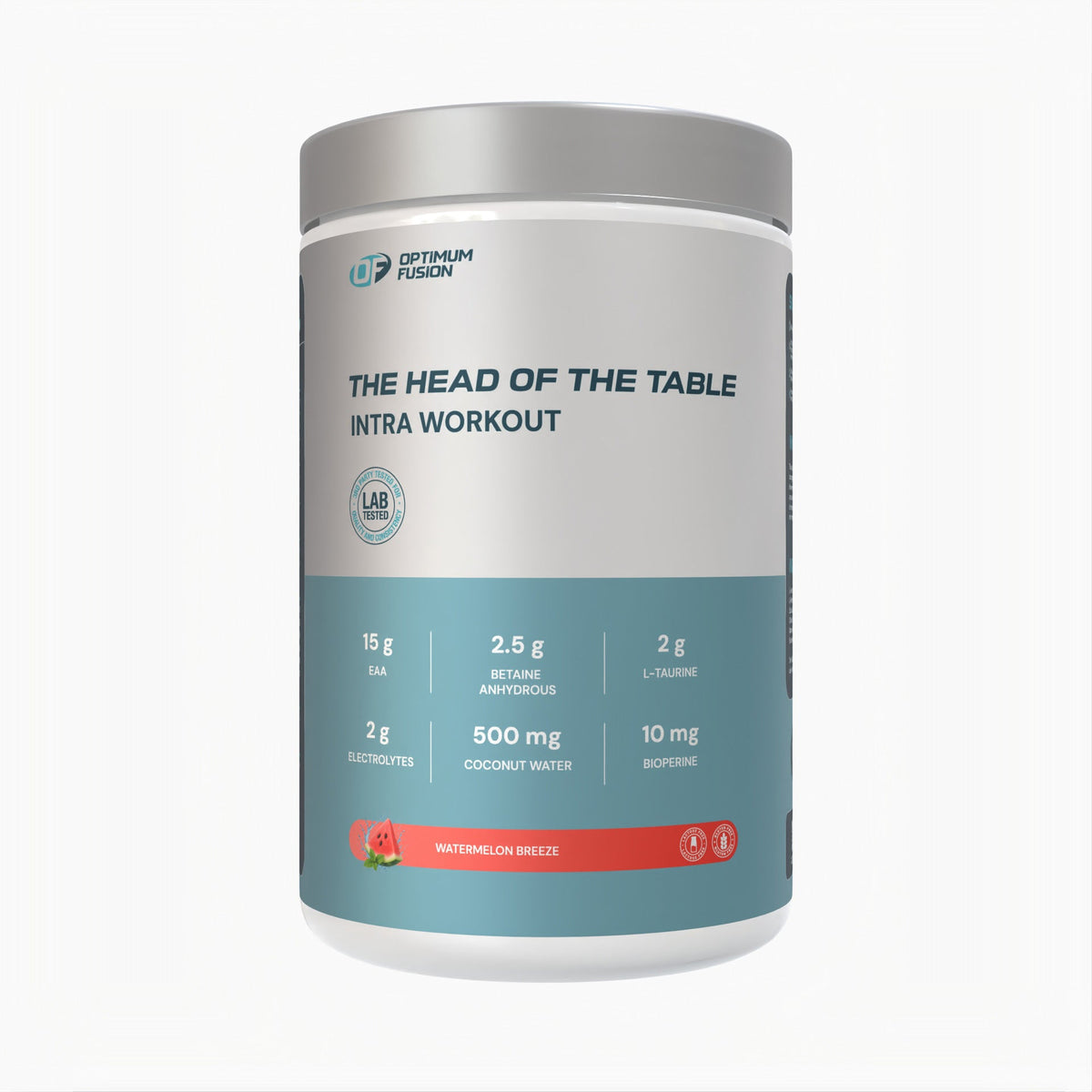
Featured Product: Head of the Table Intra-Workout EAAs
If you want EAAs and hydration support in one scoop, Head of the Table is our intra-workout formula built for exactly this use. Each serving provides:
| Ingredient | Per serving |
|---|---|
| Essential amino acids (EAAs) | 15 g |
| – of which leucine | 3.5 g |
| Betaine | 2.5 g |
| Taurine | 2 g |
| Electrolytes | Five-mineral blend |
| Coconut water powder | 500 mg |
| Servings per container | 30 |
With 3.5 g of leucine, a single scoop sits above the 2.5–3 g leucine range discussed above, and it delivers all nine essential amino acids rather than just three. Head of the Table is halal certified, third-party lab tested, and comes with fast delivery across the UAE.
How to use: mix one scoop in 600–750 ml of cold water and sip during training. On fasted mornings, start sipping 10–15 minutes before your first set. During Ramadan, use it only in your eating window. You can view Head of the Table here.
Health note: Amino acid supplements are intended for healthy adults. If you are under 18, have a kidney or liver condition, or take regular medication, speak with your doctor before using them.
Frequently Asked Questions
Are EAAs better than BCAAs for building muscle?
Yes, for most people. EAAs include all nine essential amino acids, including the three BCAAs, so they provide both the leucine signal and the building blocks muscle needs. BCAAs alone supply only three, which research such as Wolfe's 2017 review suggests limits how much muscle protein synthesis they can support.
Do I need EAAs if I already drink a whey protein shake?
Usually not. A quality whey isolate already contains EAAs; for example, one scoop of Opti Isolate provides 13.7 g of EAAs and 7 g of BCAAs. EAAs become useful mainly during training, on fasted mornings, or when you cannot have a full shake.
How much leucine should one serving contain?
Most evidence, including the ISSN position stand on protein and exercise, points to roughly 2.5–3 g of leucine per serving for a strong muscle-building signal in adults. Larger or older lifters may benefit from the higher end of that range.
Can I take EAAs while fasting in Ramadan?
No. Any drink, including EAAs, breaks the fast. Take them at iftar or suhoor, or during a workout scheduled after iftar. Many UAE lifters train 60–90 minutes after iftar so they can sip EAAs and water during the session.
Is it okay to take EAAs and creatine together?
Yes. EAAs and creatine work in different ways and are commonly mixed in the same bottle. Creatine can be taken at any time of day at 3–5 g, so adding it to your intra-workout drink is a simple way to stay consistent.
Do BCAAs or EAAs break a fat-loss diet?
They contain calories, roughly 4 kcal per gram, so a 15 g EAA serving adds about 60 kcal. That is small, and it may help support muscle retention while cutting, but it still counts towards your daily total.
The Bottom Line
BCAAs were popular for years, but the science now points clearly to EAAs as the more complete choice, since muscle needs all nine essential amino acids to grow. Still, your daily protein total comes first: calculate it with our protein and macro calculator, then use EAAs where they add real value — fasted mornings, long hot sessions and Ramadan training windows. To learn more, read EAA Supplements UAE: Why Athletes Are Upgrading and our intra-workout drink guide.
Share:
Collagen vs Whey Protein: Which Do Lifters Need? (UAE)
Cardio and Muscle Loss: How to Do Cardio Without Losing Gains