


Almost 70% of South Asian and Middle Eastern adults are lactose intolerant but most protein powders in Dubai are whey-based. That mismatch isn't a minor inconvenience. It's the reason thousands of UAE gym-goers are bloating, cramping and cutting workouts short with stomach problems that have nothing to do with how hard they trained.
If you've been tolerating the discomfort because you didn't think there was a better option, this guide is for you. Lactose free protein powder in the UAE is no longer a niche category and the best formulations are now built right here.
What Is Lactose Intolerance and Why It Matters for Gym-Goers

Lactose intolerance is the inability to fully digest lactose, the sugar found in dairy products. It occurs when the body produces insufficient quantities of lactase, the enzyme responsible for breaking lactose down. Undigested lactose passes into the large intestine where gut bacteria ferment it, producing gas, bloating and in many cases, significant digestive distress.
Globally, lactase deficiency affects roughly 68% of the adult population. In South Asian and Arab populations which make up a substantial portion of the UAE's residents and citizens that figure rises to between 70% and 80%. Despite this, the sports nutrition market here has historically been dominated by whey concentrate and whey casein blends, both of which contain meaningful amounts of lactose.
For gym-goers specifically, the problem is compounded. Protein supplements are consumed frequently, often on an empty stomach or immediately post-training two conditions that heighten digestive sensitivity. A single serving of whey concentrate can contain 4g–6g of lactose. For someone with moderate to severe lactase deficiency, that's enough to trigger symptoms within 30–90 minutes of consumption.
The result:
Athletes are either tolerating real discomfort in pursuit of their protein targets or they're avoiding supplementation altogether and falling short of what their training demands.
Signs Your Current Protein Powder Is Causing Issues
Lactose intolerance symptoms from protein supplements are often misattributed to eating too fast, training too hard or general digestive sensitivity. Here are the specific signs that your protein powder is the actual problem:
-
Post-Shake Bloating: Bloating within 1–2 hours of your shake consistent post-shake bloating that doesn't occur after whole food protein sources is a strong indicator. If it happens after chicken and rice but not after your shake, that's a different picture. If it's the shake and not the chicken, the shake is the variable.
-
Excessive Gas: Excessive gas during or after training if you're training within a couple of hours of your protein intake and experiencing significant gas, undigested lactose fermenting in your gut is a likely cause.
-
Loose Stools: Loose stools or urgency after shaking is one of the most reported symptoms from lactose-intolerant athletes who persist with whey concentrate. The osmotic effect of undigested lactose draws water into the bowel.
-
Abdominal Cramping: Cramping that isn't DOMS muscle soreness from training has a specific delayed onset and location. Abdominal cramping that follows protein intake within the same day is a different category of discomfort entirely.
-
Symptoms Improve Without Protein Powder: The symptoms disappear when you skip the shake; this is the clearest signal of all. If you feel better on rest days when you're not using your protein powder, the protein powder is the problem.
-
Residual Lactose in Whey Isolate: Whey isolate reduces lactose content significantly compared to concentrate, but it doesn't eliminate it. For athletes with genuine lactase deficiency, even the residual lactose in a whey isolate can be enough to cause symptoms under high-frequency supplementation.
Best Lactose-Free Protein Sources for UAE Athletes

Not all dairy free protein in Dubai options are created equal. Here's how the main alternatives break down:
Beef protein isolate derived from hydrolysed beef collagen and muscle tissue, beef protein is completely free of dairy and lactose. It delivers a complete amino acid profile, high leucine content for muscle protein synthesis and typically 90%+ protein by weight. Digestion is efficient, absorption is steady and there's no lactose variable at any stage of production.
Plant protein blends pea, rice and hemp proteins are all naturally dairy-free. A well-formulated blend can approach a complete amino acid profile, though leucine content is generally lower than animal-based options. Quality matters significantly here single-source plant proteins have notable amino acid gaps.
Egg white protein naturally lactose-free and a complete protein source with excellent bioavailability. Less common in the UAE supplement market but a solid option for athletes who aren't avoiding eggs.
Whey isolates technically low-lactose rather than lactose-free. The vast majority of lactose is removed during the isolation process, but trace amounts remain. For many people with mild intolerance this is sufficient; for those with significant lactase deficiency, it isn't.
For UAE athletes who want to supplement confidently without digestive risk, beef protein isolate sits at the top of the category complete, concentrated and completely clear of dairy at every stage.
Beef Protein vs Whey Protein The Lactose-Free Switch
The comparison between beef and whey comes up constantly in the lactose intolerance supplements UAE conversation. Here's the direct breakdown:
-
Lactose content: Beef protein zero. Whey concentrate 4g - 6g per serving. Whey isolate trace amounts that vary by manufacturer and batch.
-
Amino acid profile: Both are complete proteins containing all nine essential amino acids. Whey has a slight edge in leucine concentration per gram beef protein delivers comparable muscle protein synthesis outcomes in research settings when leucine content is matched.
-
Digestion speed: Whey is fast-absorbing, making it popular for the immediate post-workout window. Beef protein has a moderate absorption rate fast enough for post-workout use, steady enough to sustain amino acid availability.
-
Additional nutrients: Beef protein retains creatine from the source material in most formulations, a meaningful addition for strength and power athletes. Whey doesn't provide this.
-
Gut tolerance: For lactose-intolerant athletes, this is the deciding factor. Beef protein causes zero lactose-related symptoms because there is no lactose to cause them. The switch from whey to beef protein is one of the most reliable dietary interventions for athletes who've been suffering through whey-related digestive issues.
The transition is simple, same timing, same serving size, same protein function without the gut penalty.
Gluten-Free AND Lactose-Free: Double Clean Nutrition

Lactose intolerance and gluten sensitivity frequently co-occur, particularly in populations with South Asian and Middle Eastern heritage. Non-coeliac gluten sensitivity affects an estimated 6% of the population globally, with higher rates reported across parts of the MENA region. For athletes managing both, the supplement market creates a real problem: most products address one or neither.
Gluten free protein in UAE options are available, but finding a product that's verifiably both gluten-free and lactose-free and can prove it through third-party testing is a different challenge.
Gluten contamination in supplements typically enters during manufacturing, when protein powders share facilities with wheat-containing products.Even a product with no gluten-containing ingredients can carry a contamination risk from shared equipment.
Third-party lab testing is the only way to verify that a product is actually clean rather than just labelled clean. Batch-level testing checks for what's in the product, not just what's supposed to be in it.
For athletes with both sensitivities, the non-negotiable standard is: no dairy-derived ingredients, no gluten-containing ingredients and independent laboratory verification of both. Anything short of that is a labelling claim, not a guarantee.
OptimumFusion UAE's Only Fully Lactose-Free Supplement Brand
Most brands offer one or two dairy-free options alongside a wider range that includes whey. OptimumFusion is built differently: every product across the entire range is lactose-free and gluten-free by design, not as an afterthought.
This isn't a label strategy. It's a formulation commitment that reflects the actual dietary makeup of the UAE's fitness population, the majority of whom have some degree of lactase deficiency and shouldn't have to navigate a brand's product range looking for the safe options.
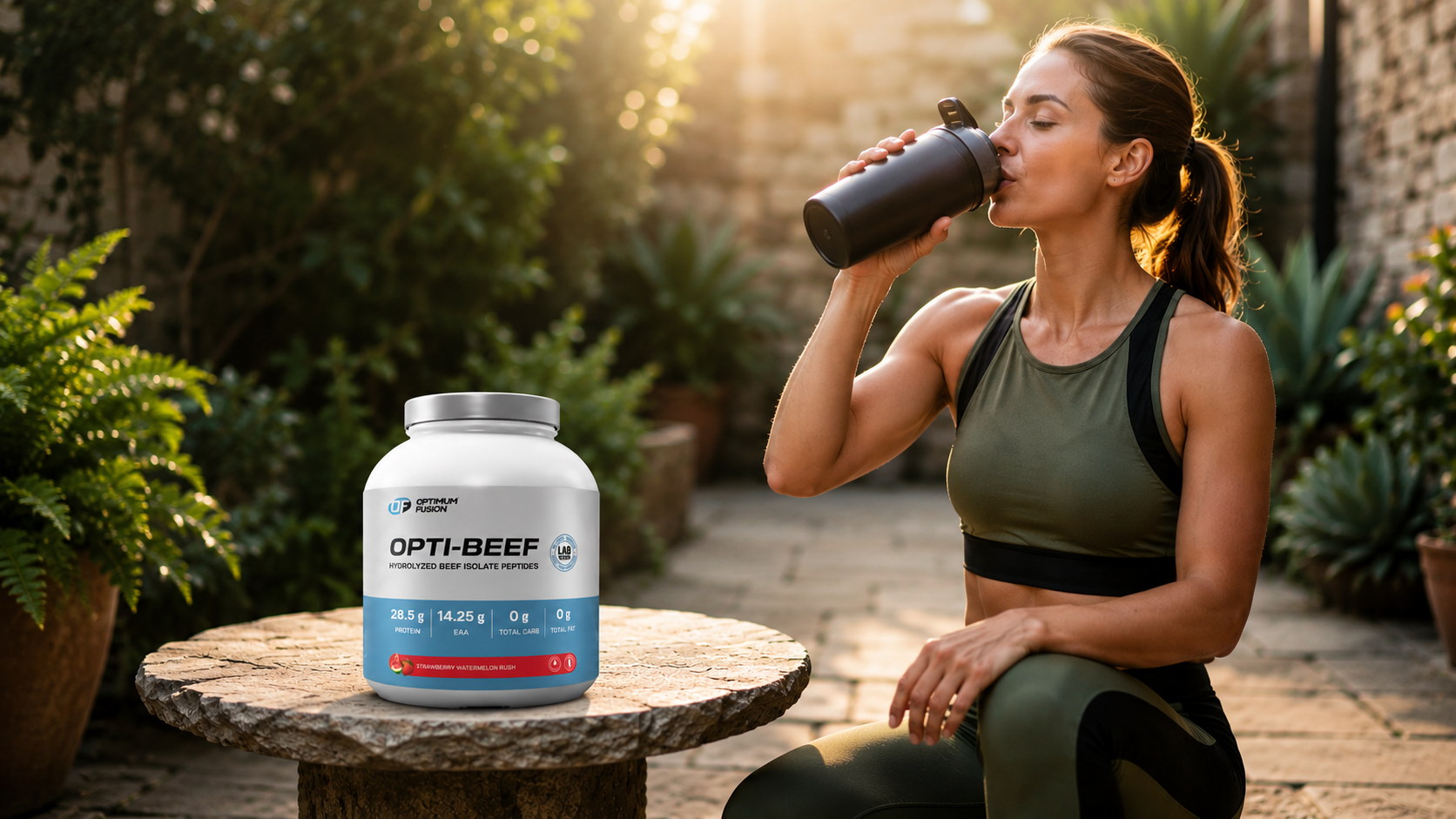
Opti-Beef is the flagship protein a premium beef protein isolate that delivers:
-
Complete EAA profile with high leucine for muscle protein synthesis
-
Natural creatine content from beef-sourced raw material
-
Zero lactose not trace amounts, zero
-
Zero gluten third-party lab tested, not just labelled
-
3rd party batch testing on every production run
-
UAE-made, with next-day delivery across the Emirates
This is what lactose free protein powder in UAE should look like, not a compromise product for people with restrictions, but a full-performance formula that the majority of UAE athletes are actually better served by.
Frequantly Asked Questions (FAQs)
Is beef protein powder safe for people with dairy allergies, not just intolerance?
Yes, Beef protein isolate contains no dairy-derived ingredients at any stage of production. It is suitable for athletes with dairy allergies as well as lactose intolerance. Always check the specific product's manufacturing disclosure if cross-contamination is a clinical concern.
Does beef protein taste different from whey?
Modern beef protein isolates are highly refined and neutrally flavoured before flavouring is added. OptimumFusion's Opti-Beef is formulated to match the taste and mixability standards athletes expect from premium whey products without the chalky texture associated with early-generation beef protein powders.
Can I use Opti-Beef as a complete whey replacement?
Yes, It covers the same use cases post-workout recovery, daily protein targets, intra-meal supplementation and does so with a complete amino acid profile. For lactose-intolerant athletes, it's an upgrade rather than a compromise.
Are all OptimumFusion supplements lactose-free or just Opti-Beef?
Every OptimumFusion product across the entire range is lactose-free and gluten-free. This is a brand-wide formulation standard, not a product-specific feature. You don't need to check individual labels; the guarantee applies to everything.
Why don't more UAE supplement brands offer lactose-free options?
Most international brands formulate for global majority markets where whey protein has the highest demand. UAE-specific needs including the high prevalence of lactase deficiency in the resident population aren't the design brief for products exported here. Brands built in the UAE for UAE athletes start from a different set of assumptions.
Conclusion
The protein powder you've been using wasn't designed for your digestive biology. If you're South Asian, Arab, or from any population with high rates of lactase deficiency, a whey-based supplement isn't just suboptimal, it's actively working against your training by making every recovery session a digestive event.
Opti-Beef was built to fix that. UAE-made, fully tested, zero lactose, zero gluten, and ready for next-day delivery wherever you are in the Emirates.
Shop Opti-Beef now.
Share:
Creatine UAE: Benefits, Usage & Buying Guide
UAE Made Protein Supplements: Why Local Matters More Than You Think